
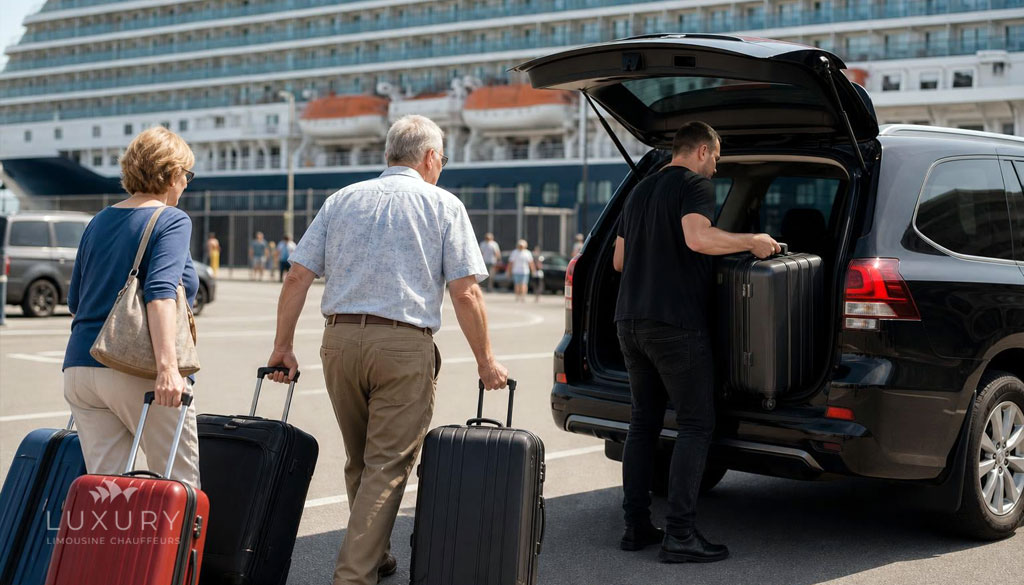
TL;DR
Getting to a cruise terminal with lots of luggage is harder than most people expect because standard taxis, rideshares, and public transport often can’t handle four or more large suitcases. Your best options in Australia are maxi taxis, shared shuttles, or private transfers with larger vehicles. Each of Australia’s major cruise terminals (Sydney OPT, White Bay, Brisbane BICT, Melbourne Station Pier) has different access rules, parking limitations, and porter availability, so planning ahead is essential.
Why Luggage Changes Everything About Getting to Your Cruise
Cruise passengers pack differently than air travellers. There are no checked bag fees, no strict weight enforcement at the terminal, and cruise lines typically just “encourage” passengers to bring no more than two suitcases each weighing up to 32 kg. The reality? Most people bring more. A couple easily ends up with four large suitcases, two carry-ons, and maybe a garment bag or two.
Now try fitting all of that into a standard sedan. It won’t work.
That’s the core problem with figuring out how to get to the cruise terminal with lots of luggage. The transport mode that works perfectly for two people with backpacks completely falls apart when you add a family’s worth of checked bags.
And this isn’t a small problem. A record 1.45 million Australians took cruise holidays in 2025, making Australia the world’s fourth-largest cruise market. More than 1.2 million cruise passengers are expected to pass through Sydney alone in the 2025/2026 season. That translates to millions of luggage-laden transfers each year, and a lot of stressed-out passengers trying to figure out logistics on embarkation morning.
If you’re one of them, this guide covers every transport option, defines the key terms you’ll encounter, and breaks down the specific quirks of Australia’s major cruise terminals.
 Get a cruise transfer quote and skip the embarkation-day stress.
Key Terms Every Cruise Passenger Should Know
Before comparing transport options, it helps to understand the terminology you’ll see on cruise line websites, terminal guides, and transfer booking pages. These definitions are specific to the cruise context, not general travel.
Bag Drop
The designated area at the cruise terminal where you hand your checked luggage to staff or porters before boarding. It usually opens around 9am on embarkation day. Your bags are tagged, sorted, and delivered to your stateroom, but this process takes two to four hours. That’s why your carry-on matters so much.
Why it matters for luggage: You need to physically get your bags from your vehicle to the bag drop zone. At some terminals, that’s a few metres from the kerb. At others, it’s a longer walk. Knowing the layout in advance saves real frustration.
Carry-On (Cruise Context)
The bag you keep with you through security and onto the ship. Unlike airline carry-ons, there’s no strict size limit, but it should contain your essentials: medications, travel documents, a change of clothes, swimsuit, and anything you’ll need in the first few hours before your checked bags arrive.
Maxi Taxi
An oversized taxi (typically seating 6 to 11 passengers) with significantly more cargo space than a standard cab. Practitioners on TripAdvisor consistently recommend maxi taxis for groups with heavy luggage, with one poster noting that with four people and lots of bags, “you will need to book a Maxi Taxi.” They’re widely available in Sydney, Melbourne, and Brisbane but should be pre-booked on cruise embarkation mornings when demand spikes.
Porter
Terminal staff who take your checked bags from the drop-off area and load them onto the ship. Not every terminal has them. Melbourne’s Station Pier offers porters on embarkation days. Sydney’s Overseas Passenger Terminal does not, meaning you handle your own bags from vehicle to bag drop.
Meet-and-Greet
When a driver meets you at a specific location (airport arrivals hall, hotel lobby) with a name sign and helps with luggage from the moment you connect. For cruise passengers flying in on the same day, this eliminates the confusion of finding your transfer at a busy airport. Learn more about how meet-and-greet works at major terminals.
Luggage Trailer
An add-on trailer towed behind a van or SUV to carry excess or oversized items like golf clubs, surfboards, or extra suitcases beyond what the vehicle’s boot can hold. This must be requested at the time of booking. If you’re unsure whether you need one, here’s a guide on how to add a luggage trailer to your transfer booking.
Fixed-Price Transfer
A quoted, upfront fare with no meter running and no surge pricing. On a busy embarkation morning in Sydney or Brisbane, rideshare surge pricing can blow your budget. A fixed-price transfer removes that uncertainty. If surge pricing is a concern for you, this breakdown of why fixed-price beats surge applies to cruise transfers too.
Flight Monitoring
When your transfer provider tracks your inbound flight’s actual arrival time and adjusts the pickup window accordingly. Critical for fly-cruise passengers who can’t control whether their plane lands on time.
Luggage Shipping
A premium service where a company collects your bags from your home or hotel and delivers them directly to your cruise stateroom. Services like Luggage Forward handle this globally. It eliminates all physical handling but costs significantly more than any ground transfer option.
Pro Tips for Travelling with Heavy Luggage to a Cruise Terminal
These are the practical details that forum threads and experienced cruisers keep repeating. They’re simple, but skipping any one of them can cause real problems on embarkation morning.
Tell your transfer provider your exact bag count and sizes at booking. This is the single most overlooked step. If you book a sedan and show up with five suitcases, the driver can’t magically fit them in. Communicating luggage details upfront ensures the right vehicle is assigned, whether that’s an SUV, van, or a vehicle with an attached trailer.
Secure your cruise luggage tags with zip ties or a staple gun. The adhesive on cruise line luggage tags is notoriously weak. If a tag falls off during the terminal’s sorting process, your bag could end up in the wrong stateroom or be delayed significantly. A few zip ties cost nothing and prevent a lot of frustration.
Pack your carry-on as if your checked bags won’t arrive for six hours. They probably won’t arrive that quickly. Checked bags can take two to four hours to reach your stateroom after you drop them. Your carry-on should have medications, chargers, a swimsuit (the pool is open immediately), documents, and a change of clothes.
Allow 15 to 20 extra minutes for loading and unloading if you have five or more bags. This isn’t just about the physical time needed. It’s also about traffic flow at the terminal. Kerb space is shared, and drivers blocking the drop-off lane cause problems for everyone.
Check vehicle capacity before you book. A standard sedan boot fits two large suitcases and maybe a carry-on or two. An SUV fits three to four large bags. A van or Sprinter can handle six to ten. A minibus with a luggage trailer can handle even more. Browse the fleet options to see which vehicle matches your luggage load.
Book early on peak embarkation dates. When a major ship like Ovation of the Seas departs from Sydney, thousands of passengers are all trying to get to the terminal within the same two-hour window. Maxi taxis, private transfers, and even regular Ubers get booked out or hit surge pricing. The earlier you lock in your transfer, the better.
Consider the physical strain. Lifting a 20 kg suitcase incorrectly, especially repeatedly, can cause acute back injuries. The issue isn’t about fitness but the biomechanics of hoisting awkward, heavy objects. For older travellers or anyone with mobility concerns, a door-to-door transfer where the driver assists with luggage isn’t a luxury. It’s a practical health decision.
When a Private Transfer Makes the Most Sense
Not every cruise passenger needs a private transfer. If you’re a solo traveller with one bag heading to Melbourne’s Station Pier, the 109 tram works fine.
But a private transfer becomes the obvious choice when:
- Your luggage exceeds what a standard taxi or rideshare can fit (more than three large bags)
- You’re travelling with elderly family members, young children, or anyone with mobility challenges
- You need guaranteed punctuality on embarkation day with no surge pricing surprises
- You’re flying into an Australian city and connecting directly to a cruise (flight monitoring means your driver adjusts if your plane is late)
- Your terminal has no public transport access (Brisbane BICT, effectively White Bay)
For these situations, a vehicle with proper luggage capacity, a driver who handles the bags, and a fixed price agreed in advance removes the biggest stress points from embarkation morning.
Request a cruise terminal transfer quote to lock in your price and vehicle.