
TLDR
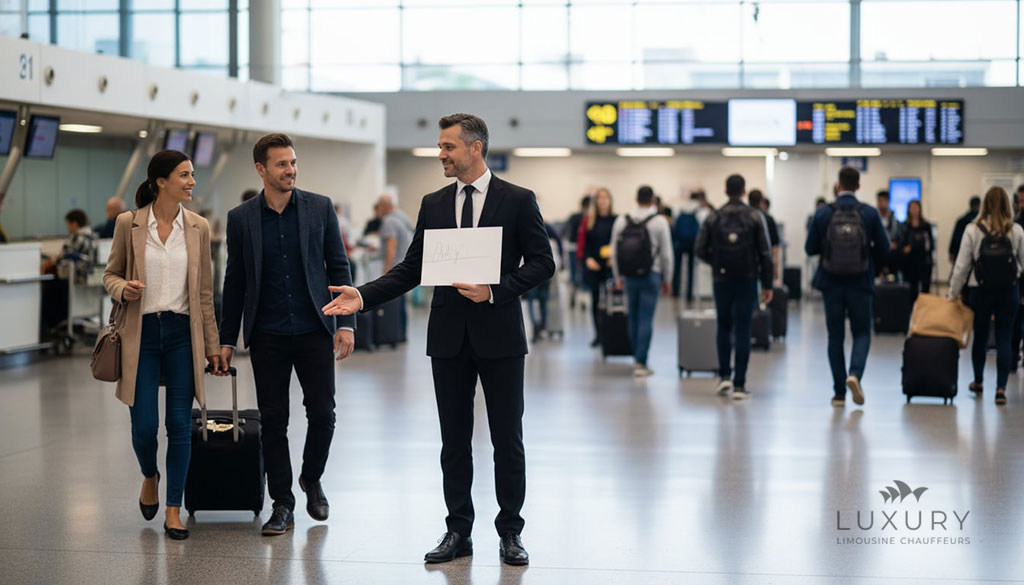
Meet-and-greet is an inside-terminal airport pickup where the chauffeur or a designated greeter meets you at arrivals with a name sign, helps with luggage, and walks you to the vehicle. In busy terminals, chauffeurs manage this by tracking your flight in real time, using the airport’s approved meeting areas and holding zones, coordinating by phone or message, and staging the vehicle legally so you never have to decode pickup zones on your own. The process is a planned logistics handoff, not just someone holding a sign.
What Does Meet-and-Greet Actually Mean in Chauffeur Service?
In chauffeur travel, meet-and-greet is the managed handoff between the aircraft landing and the car. The passenger is not expected to search for a vehicle or figure out the pickup zone alone. Instead, the chauffeur or greeter meets them at an agreed arrivals point, confirms the booking, helps with luggage, and guides them to the vehicle.
That sounds simple enough. But the term gets misunderstood constantly. On a Cruise Critic forum thread, a traveller asked whether a service’s “meet-and-greet” meant the driver would be inside the terminal near baggage claim or waiting out in the taxi and limo lane. Another replied that it depended on whether the arrival was international or domestic, and that the meeting point changed accordingly. This kind of confusion is common because different providers use the same label for very different levels of service.
The key distinction: in a proper chauffeur meet-and-greet, the chauffeur navigates to you. In a curbside pickup, you navigate to the chauffeur.
Why Busy Terminals Make Meet-and-Greet a Real Logistics Task
In a small regional terminal with one exit and a quiet car park, meet-and-greet is straightforward. At a major airport, it becomes something closer to a coordination exercise.
Australia’s busiest airports handle enormous passenger volumes. According to the ACCC’s 2024-25 airport monitoring report, Sydney Airport processed 41.8 million passengers, Melbourne handled 36.2 million, Brisbane 24.4 million, and Perth 17.5 million. Sydney Airport reported its busiest year on record for international travel in 2025, with 17.17 million international passengers through Terminal 1 alone. Perth Airport crossed 18 million passengers for the first time in 2025.
The Australian Airports Association notes that roughly 94% of Australia’s international air passengers travel through Sydney, Melbourne, Brisbane, and Perth, where international flights involve larger aircraft, more complex terminal operations, and heavier infrastructure demands.
These are not abstract numbers. They explain why how chauffeurs handle meet-and-greet in busy terminals is a genuine operational challenge. Multiple exits. Separate domestic and international buildings. Restricted pickup zones. Long walks between baggage claim and the kerb. No-standing rules that push vehicles out if they linger. The chauffeur’s job is to solve all of that before the passenger even thinks about it.
How Chauffeurs Handle Meet-and-Greet Step by Step
1. Confirm Flight, Terminal, Passenger, and Luggage Details
Before anything else, a professional chauffeur or dispatch team gathers the booking essentials: airline, flight number, terminal (domestic or international), lead passenger name, mobile number (ideally WhatsApp-capable for international travellers), number of passengers, luggage count, oversized items, child seat needs, and mobility requirements.
Practitioners on Reddit confirm this is standard practice. In a discussion about airport car services, one traveller noted that every transfer company they used “always asks for the flight number, contact phone number, and number of luggage.” That data drives the entire pickup.
If you are booking an airport transfer, it is worth choosing a vehicle that fits your passenger count and luggage from the start. The wrong vehicle creates problems that no amount of terminal coordination can fix.
2. Monitor the Flight and Adjust the Pickup Time
Professional services track flights using live data, not schedule estimates. The distinction matters. A flight scheduled to land at 8:15 AM might touch down at 7:50 or 9:30. If the chauffeur arrives based on the schedule alone, they either sit in paid parking for 75 minutes or scramble to get there late.
Some providers, like Rapid Airport Transfers, advertise 60 minutes of complimentary waiting from actual landing time, not from the scheduled arrival. The clock starts when the wheels hit the tarmac, which gives the passenger time for taxiing, disembarkation, immigration, baggage claim, and customs.
Worth noting: landing time is not the same as “passenger ready” time. For an international arrival, the gap between touchdown and walking through the customs exit can be 30 minutes to over an hour, depending on queues, biosecurity checks, and baggage carousel speed.
3. Use the Airport’s Approved Meeting or Holding Area
This is the step most competitors gloss over, and it is arguably the most important part of how chauffeurs handle meet-and-greet in busy terminals.
Airports do not let commercial drivers park wherever they want. Each major Australian airport has specific rules:
Sydney Airport requires registered limousines and buses to use dedicated collection zones. Commercial drivers must use holding areas when not collecting pre-booked passengers and cannot leave vehicles unattended at terminal frontages. The rules even differ between terminals: at International, limousine drivers may leave the vehicle in the designated Ground Transport Zone to meet passengers inside, but at Domestic, drivers must stay with the vehicle unless they park at Terminal Court.
Melbourne Airport requires chauffeur and hire cars to be pre-arranged, with fees agreed in advance and no meter. Passengers are met at designated chauffeur/hire car meeting points inside the airport.
Brisbane Airport states that pickup and drop-off areas are “No Standing” zones. Passengers must be ready for immediate pickup, drivers waiting in those zones will be asked to move on, and unattended vehicles are not allowed.
Adelaide Airport says international passengers can be met in the arrivals hall after customs and immigration, but anyone meeting a passenger by car must park because the pickup zone is curbside only. The designated chauffeur pickup and drop-off area sits on level 4 of the terminal car park.
A professional chauffeur already knows these rules. The passenger does not have to.
4. Wait Visibly with the Agreed Sign
The name board is a tool, not the service itself. The chauffeur positions themselves where passengers exit, whether that is the customs exit, arrivals hall, baggage claim area, or designated meeting point, depending on what the airport allows.
Practitioner guidance recommends high-contrast signage positioned where passengers come through without blocking security lines. For VIP or privacy-sensitive passengers, the sign might show a company name, event name, initials, or an agreed phrase instead of the full passenger name. If you need that kind of discretion, it helps to request discreet chauffeur service when booking.
5. Confirm the Passenger and Destination
Once the chauffeur identifies the passenger, they confirm the name, booking, and destination. This is not just politeness. It is a safety step, especially in a busy terminal where multiple passengers are exiting at once and several drivers may be holding signs.
Good chauffeurs also confirm the route, any planned stops, and whether the passenger prefers quiet travel or conversation. Small details, but they shape the experience from terminal to destination.
6. Assist with Luggage and Guide the Passenger to the Vehicle
After greeting, the chauffeur helps with luggage (asking before grabbing bags, which experienced drivers know to do) and escorts the passenger through the terminal-to-vehicle route. That route is not always the shortest path. It is the legal one, through the right lift, car park level, link bridge, or chauffeur zone.
At some airports, the walk from arrivals to the vehicle can be significant. Practitioners on Reddit describe Sydney’s domestic pickup points and parking as “a fair walk away” from where passengers exit baggage claim, while taxi and hire car pickup areas are closer. That walking distance is one reason families, older travellers, and people with heavy luggage value having a guide.
7. Use Backup Contact if the Terminal Is Crowded or Something Changes
Plans fail sometimes. The passenger exits a different door. Baggage takes 45 minutes. The arrivals hall is shoulder-to-shoulder with people. The chauffeur’s sign is obscured.
The backup plan should already be in place before the flight lands: the passenger has the chauffeur’s direct phone number or WhatsApp, the booking reference, and a fallback meeting point. Transfeero, a major transfer platform, notes that when meet-and-greet is affected by external circumstances, the driver contacts the passenger with detailed pickup instructions rather than leaving them stranded.
This step is where the gap between a professional chauffeur service and a casual pickup becomes obvious. Having a plan B is not optional in a busy terminal. It is part of the service.
The Greeter-Driver Split: Something Most Articles Miss
In a standard transfer, the chauffeur personally meets the passenger and drives the car. In very busy terminals, some services split those roles.
A traveller on Reddit described this from experience at Taipei’s airport: the person waiting with the name sign was not the driver but a greeter who contacted the driver and walked them outside. A practitioner post about Chicago O’Hare described a similar staging model where a greeter waits near baggage claim while the chauffeur stays in a staging area, then pulls up once the passenger is ready and at the kerb.
This model exists because airports restrict kerbside waiting. If the driver cannot idle at the pickup lane, someone needs to be inside the terminal while the vehicle waits legally off-kerb. The greeter solves that problem.
When booking, it is worth asking: will the person who meets me also be the driver? Either arrangement works, but knowing what to expect removes a moment of confusion right when you are most tired.
Meet-and-Greet vs Curbside Pickup vs Rideshare
Understanding how chauffeurs handle meet-and-greet in busy terminals becomes clearer when you compare it with the alternatives.
| Pickup Type | Where You Meet | Who Navigates the Terminal? | Best For | Weakness |
|---|---|---|---|---|
| Meet-and-greet chauffeur | Arrivals hall, baggage claim, customs exit, or designated chauffeur point | Chauffeur or greeter | International arrivals, VIPs, families, older travellers, groups, heavy luggage | May involve parking fees or higher service cost |
| Curbside chauffeur pickup | Approved curbside or chauffeur pickup zone | Passenger walks to the zone | Frequent flyers, light luggage, simple domestic arrivals | Can be difficult in restricted or confusing pickup areas |
| Rideshare | App-designated pickup zone | Passenger | Budget trips, familiar airports | Surge pricing, driver cancellation, pickup-zone confusion, no terminal greeting |
| Airport concierge or VIP meet-and-assist | May include secure-side assistance where authorised | Concierge | VIP, mobility needs, tight connections | Separate service from standard chauffeur transfer |
The comparison comes down to one question: after a long flight, do you want to figure out the pickup zone, or do you want someone who already knows?
For anyone weighing the costs, understanding what is included in a fixed-price airport transfer helps separate genuine value from unnecessary extras.
Why Rideshare Falls Short at Busy Airports
Rideshare apps work well in many situations. Airport pickups in busy terminals are not one of them.
Practitioners on an Uber drivers forum discussed why passengers should not request rides before collecting luggage: drivers may be unable to wait in airport pickup areas and get forced to circle or use specific rideshare zones, running up the passenger’s time and frustration.
The problem gets worse when travellers are tired. In a Melbourne Reddit thread, a traveller described an alleged Uber pickup scam after an overnight flight: the driver left the pickup zone before requesting the PIN, claimed it did not work, and tried to switch the trip to a private cash payment. Another commenter described a similar experience and said fatigue after an overnight flight made them more likely to go along with a suspicious arrangement.
A pre-arranged chauffeur meet-and-greet does not eliminate all risk, but it reduces ambiguity. The passenger has the driver’s name, contact number, vehicle details, and booking reference before the plane lands. There is no surge pricing, no hunting for a pickup pin, and no uncertainty about who is actually driving.
For more on this, the chauffeur safety and privacy guide covers how to verify driver identity and protect personal information during transfers.
What Meet-and-Greet Includes, and What It Does Not
Typically included:
- Real-time flight monitoring
- A confirmed meeting point inside the terminal or at the designated chauffeur area
- Name board or agreed identification sign
- Direct chauffeur or dispatch contact (phone, SMS, WhatsApp)
- Luggage assistance
- Escort from the arrivals point to the vehicle
- Coordination with dispatch if the airport is congested or the pickup point changes
Not usually included:
- Immigration fast-track or customs assistance inside controlled areas
- Gate-side or secure-side meeting (greeters are not permitted past customs or federal inspection areas)
- Airline-provided mobility assistance (that is arranged with the airline separately)
- Porter service unless specifically booked or included
- Permission to override airport security or parking rules
This distinction matters. If you are booking a meet-and-greet, the chauffeur will be waiting after you clear customs, collect bags, and walk through to the public arrivals area. They will not be at the aircraft door or inside the immigration queue. Any service that offers secure-side escorting is a separate airport-authorised concierge or airline service, not a standard chauffeur pickup.
Common Busy-Terminal Problems and How Chauffeurs Solve Them
Here is where how chauffeurs handle meet-and-greet in busy terminals gets practical. Every one of these scenarios happens regularly at major airports.
The Flight Is Delayed
The chauffeur or dispatch tracks the flight and adjusts the pickup window. A professional service does not send the driver into paid parking two hours early. They time the arrival based on real-time data. Some providers include a complimentary waiting period that starts from actual landing, not the original schedule. Policies vary, so it is worth confirming what happens if a delay stretches beyond the included wait time.
The Flight Arrives Early
Less common, but it creates its own problem. The chauffeur adjusts, but an early landing does not mean the passenger is immediately ready. Taxiing, disembarkation, baggage, and (for international flights) customs still take time. Experienced chauffeurs time their terminal entrance around actual passenger-ready time, not just wheels-down.
Baggage Is Slow
Flight tracking tells the chauffeur when the plane lands. It says nothing about when bags appear on the carousel. This is where passenger communication matters. A quick text saying “bags haven’t arrived yet” keeps the chauffeur in the holding area instead of circling the terminal. As one practitioner put it: flight tracking solves aircraft timing, but passenger communication solves baggage timing.
The Passenger Cannot Find the Chauffeur
Direct phone or WhatsApp contact resolves this quickly. The chauffeur sends their exact location, the sign they are holding, and what they are wearing. A backup meeting point (such as a specific cafe, information desk, or exit number) should be agreed before the flight.
The Vehicle Cannot Wait at the Kerb
This is the norm, not the exception, at busy Australian airports. Brisbane’s No Standing zones, Sydney’s holding area requirements, Adelaide’s park-to-meet rules: they all mean the car will not be idling at the door. The chauffeur either parks legally or waits in a staging area and pulls up when the passenger is ready at the approved pickup point.
The Passenger Is Travelling with a Group
Groups arriving on the same flight are straightforward. Groups arriving on different flights need coordination: who arrives first, where do they wait, when does the vehicle come? For larger parties, it is worth exploring group airport transport options and coordinating multiple passenger arrivals under one booking.
The Passenger Needs Privacy
Corporate VIPs, public figures, and government travellers sometimes prefer not to have their full name on a sign in a crowded arrivals hall. The sign can show initials, a company name, an event name, or nothing at all, with identification handled by phone contact instead. This is a small detail that makes a large difference for the right passenger.
When Meet-and-Greet Is Worth Requesting
Not every airport trip needs meet-and-greet. But certain situations make it clearly worthwhile:
- International arrivals, where the passenger exits into an unfamiliar terminal after customs, immigration, and biosecurity
- First-time visitors to a city who do not know the terminal layout
- Families with children, strollers, car seats, and multiple bags (for families, it helps to request child seats or booster seats when booking)
- Older travellers who may find busy terminals overwhelming
- VIPs, executives, and government or board-level travellers who need smooth, private pickups
- Groups with heavy luggage or coordination needs
- Late-night or early-morning arrivals when fatigue is a factor
- Guests being welcomed by a company, hotel, wedding party, event planner, or tour organiser
- Airports with confusing or under-construction pickup zones
- Passengers arriving after long-haul flights of 8 hours or more
A Reddit user in a Brisbane thread summed up the real motivation: they had “someone important” arriving on a domestic flight and did not want them to get lost or wait. That is the core of it. People pay for meet-and-greet because they do not want important guests decoding the airport alone.
When Curbside Pickup Is Enough
Meet-and-greet is not necessary for every trip. Curbside pickup works well when:
- The traveller flies through that airport regularly and knows the layout
- It is a simple domestic arrival
- The passenger has carry-on luggage only
- The pickup zone is familiar and easy to reach
- Cost is the main priority
What Travellers Should Provide When Booking
A smooth meet-and-greet starts with the right information at booking. Here is what to have ready:
- Airline and flight number
- Arrival date and scheduled time
- Domestic or international terminal (if known)
- Lead passenger name
- Mobile number (WhatsApp-capable for international travellers)
- Number of passengers
- Luggage count and any oversized items
- Child seat or booster seat needs
- Mobility requirements
- Preferred wording on the name sign
- Destination address and any intermediate stops
- Whether the traveller is a first-time visitor, elderly, VIP, or part of a group
For a step-by-step booking walkthrough, the guide on how to request a meet-and-greet at airport pickup covers each of these points in detail.
A Quick Glossary: Terms That Get Confused
Because travellers and even some providers use these terms loosely, it helps to define them:
Chauffeur meet-and-greet: The chauffeur or greeter meets the passenger inside the terminal or at a designated meeting point, assists with luggage, and escorts them to the vehicle.
Greeter: A person (not always the driver) who meets the passenger inside the terminal and coordinates with the chauffeur waiting at the vehicle or staging area.
Airport concierge or meet-and-assist: A separate airport-authorised service that may include secure-side assistance, immigration queueing support, or lounge access. Not the same as a chauffeur meet-and-greet.
Porter: Someone who helps carry luggage, typically from the terminal to the vehicle. May or may not be part of a chauffeur service.
VIP fast-track: An airport or third-party service that expedites immigration, customs, or security. Requires airport authorisation and is separate from standard chauffeur pickup.
Curbside pickup: The chauffeur waits at or near the kerb in an approved zone. The passenger walks to the vehicle.
Designated chauffeur/hire car zone: An airport-specific area where commercial chauffeur vehicles are permitted to wait and collect passengers.
Australia-Specific Airport Pickup Rules
Airport pickup rules vary by city, and a professional chauffeur adapts the meeting point to the airport rather than using one generic process. Here is a snapshot of how Australian airports structure chauffeur access:
| Airport | Key Rule |
|---|---|
| Sydney | Registered limousines use dedicated zones. Drivers must use holding areas when not collecting passengers. Rules differ between International and Domestic terminals. |
| Melbourne | Chauffeur/hire cars are pre-arranged with agreed fees. Passengers are met at designated inside-airport meeting points. |
| Brisbane | Pickup/drop-off areas are No Standing zones. Passengers must be ready for immediate collection. |
| Adelaide | International arrivals can be met in the arrivals hall after customs. Anyone meeting by car must park. Chauffeur pickup is on level 4 of the terminal car park. |
| Perth | With over 18 million passengers in 2025 and growing, clear pickup instructions and staging coordination are increasingly important. |
These rules change. Construction, new terminals, seasonal adjustments, and updated commercial vehicle policies all affect where and how chauffeurs position themselves. Always confirm the current meeting point with your provider before travelling.
FAQs
Usually in the arrivals hall, near baggage claim, near the customs exit, or at the airport’s designated chauffeur/hire car meeting point. The exact location depends on the airport and terminal. Melbourne Airport, for example, has specific inside-airport chauffeur meeting points. Adelaide requires international greeters to wait in the arrivals hall after customs. Your chauffeur should confirm the exact spot before your flight.
No. Standard chauffeur meet-and-greet happens landside, after you have cleared the secure area. That means after immigration, baggage claim, and customs for international flights. Gate-side meeting, immigration fast-track, and secure-side escorting are separate airport-authorised services that must be arranged independently.
Professional chauffeur services track the flight and adjust the pickup time automatically. Waiting-time policies vary by provider: some start the complimentary wait period from actual landing, others from scheduled arrival. Always check the policy when booking. If a delay stretches beyond the included wait time, the provider should contact you with updated instructions rather than leaving without notice.
Call or message the chauffeur directly using the contact details shared before your flight. A good provider will have a backup meeting point and send you precise instructions, including their exact location and a description of what they are holding or wearing. This is why having the chauffeur’s phone number or WhatsApp before landing is so important.
Not always. In simpler transfers, the chauffeur personally meets the passenger. In busy terminals where kerbside waiting is restricted, a separate greeter may meet you inside, help with luggage, and coordinate with the chauffeur waiting at the staging area or vehicle. Either way, the process should be communicated to you before arrival.
Luggage assistance is normally part of a chauffeur meet-and-greet. That said, always disclose your luggage count, oversized items, and any special equipment when booking. The right vehicle and enough hands to help depend on knowing what you are travelling with.
Most busy airports restrict waiting, idling, and unattended vehicles at the kerb. Brisbane’s pickup zones are No Standing areas. Sydney requires commercial drivers to use holding areas when not collecting passengers. The chauffeur works within these rules, staging legally and pulling up when you are ready. That is part of the service.
It is more controlled. You have a pre-arranged booking, direct driver or dispatch contact, vehicle details, and a confirmed meeting point before you land. There is no surge pricing and no ambiguity about who is picking you up. User reports from Sydney and Melbourne describe rideshare pickup confusion and alleged scam behaviour at airports, which supports the value of confirming driver identity, vehicle, and booking details before getting into any car. That said, no transport option is completely risk-free, so always verify the details match.
Choosing a Provider That Gets This Right
The difference between a name on a sign and a proper meet-and-greet comes down to preparation, compliance, and communication. When booking, confirm that the provider monitors your flight, shares chauffeur contact details before pickup, knows the specific airport’s rules, and has the right vehicle for your passengers and luggage.
Luxury Limousine Chauffeurs provides private airport transfers across major Australian cities, with meet-and-greet coordination, pre-shared chauffeur contact, real-time flight monitoring, fixed-price single journeys, and a fleet that covers solo travellers, executives, families, and groups. To confirm your terminal pickup details, luggage needs, or special requests, get in touch directly.
📞 Call 1300 011 077 or +61 400 777 103 to speak with our team.
🌐 Book now at luxurylimousinechauffeurs.com.au
Disclaimer: The images used in this blog may include AI-generated content and are intended for informational and illustrative purposes only. All trademarks, logos, and copyrights remain the property of their respective owners. If you believe any content infringes your rights, please contact us and we will review and address your request promptly.