
TLDR
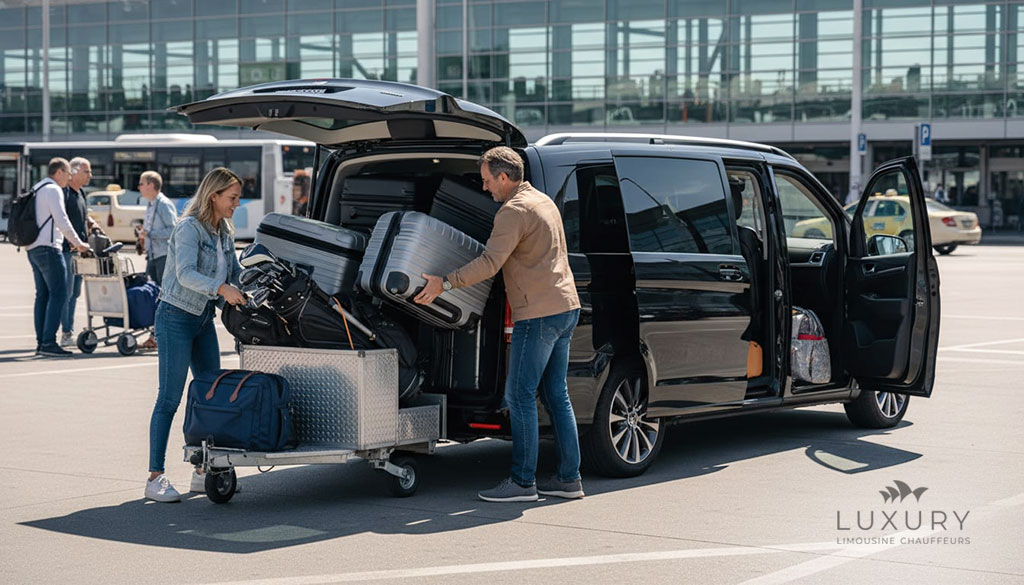
Extra luggage in a transfer booking is any baggage beyond what the booked vehicle can comfortably and safely carry, including additional suitcases, sports gear, prams, or bulky items. A luggage trailer is a separate trailer attached to a suitable vehicle when internal cargo space is not enough. To add extra luggage or a trailer, provide full passenger and bag details before confirmation (or contact the provider with your booking reference as soon as luggage changes). The provider will then confirm whether your vehicle is suitable or whether you need a larger vehicle, trailer, or second vehicle.
Most people book a transfer based on how many passengers are travelling. That works fine when everyone has a single bag. It falls apart when the group shows up at the airport with six oversized suitcases, a pram, and a set of golf clubs.
The fix is simple but often overlooked: declare your luggage before the pickup, not during it. Adding extra luggage or a trailer to a transfer booking is a vehicle-allocation step, not just an admin checkbox. It determines which vehicle the provider sends, whether a trailer is attached, or whether a second vehicle is dispatched.
This guide explains what counts as extra luggage, when you need a trailer, how to request either one before or after booking, and what details to provide so your transfer runs without surprises.
What Does “Extra Luggage” Mean in a Transfer Booking?
Extra luggage means baggage beyond the standard luggage allowance for your booked vehicle. Many transfer providers use one checked suitcase plus one carry-on per passenger as a planning baseline, though the confirmed allowance depends on the provider and vehicle type. Ram’s Airport Transfer, for example, lists one large suitcase and one carry-on as standard, while Book Taxi Australia gives a standard suitcase limit of 140 cm total size per passenger.
Anything beyond that baseline counts as extra. Common examples include:
- Additional suitcases beyond one per person
- Surfboards, golf clubs, skis, snowboards, or bike boxes
- Musical instruments in hard cases
- Prams, strollers, or portable cots
- Wheelchairs and mobility aids
- Exhibition materials, boxed items, or trade-show equipment
- Large garment bags for weddings or events
- Cruise luggage (which tends to be heavier and more numerous than typical airport bags)
Oversized items deserve special attention. Klook’s luggage policy defines oversized items such as bikes, strollers, and foldable wheelchairs as counting as two pieces of luggage each. Shape matters as much as weight. A surfboard takes up more usable space than two suitcases stacked together.
What Is a Luggage Trailer?
A luggage trailer is a separate enclosed or secured trailer attached to a suitable transfer vehicle to carry bags or bulky items when the vehicle’s internal cargo space is not enough.
Trailers are not a universal add-on. They change the booking because:
- The vehicle must be legally equipped and rated to tow.
- The driver must be comfortable and experienced with the setup.
- The trailer must be physically available in the right city on the right date.
- Airport pickup areas and hotel driveways can be harder to access with a trailer attached.
- Loading time increases.
- Bags must be properly secured and protected from movement.
- Some premium vehicles (sedans and certain SUVs) cannot tow trailers at all.
Industry policies confirm this variability. Hughes’ terms list trailers as an additional-charge add-on but state they are not permitted on sedans or SUVs and are subject to availability. SkyDrive Transfers notes that groups over five passengers or those with excess luggage may benefit from a luggage trailer, while smaller groups may fit bags internally. DC Limousines Noosa offers luggage trailers on request alongside the option to upgrade to a larger vehicle.
The bottom line: a trailer is not just a boot extension. It is a separate logistical arrangement that needs to be confirmed before travel.
Quick Answer: How to Add Extra Luggage or a Trailer
Here is the process in short:
- Count all passengers, including children and infants.
- Count every checked bag, carry-on, and personal item.
- List any oversized, long, rigid, or heavy items separately.
- Include approximate dimensions for anything unusual.
- Enter these details in the booking form’s luggage, extras, or special request field.
- If there is no specific field, write it in the comments or contact the provider directly before confirmation.
- Ask whether the selected vehicle is suitable or whether a larger vehicle, luggage trailer, or second vehicle is needed.
- Save the written confirmation that reflects the luggage plan.
If you have already booked and your luggage situation has changed, contact the provider with your booking reference immediately. The earlier you do this, the more options are available.
When You Need to Request Extra Luggage Space
Not every booking needs special luggage planning. But certain situations almost always do.
The two-bag trigger. If any passenger has more than one checked suitcase, or if the vehicle will be close to full passenger capacity, treat the booking as a luggage-review booking. Those are the cases most likely to require a larger vehicle, luggage trailer, or second vehicle.
Here are the most common scenarios:
- Long-haul international travellers returning with multiple checked bags per person
- Cruise passengers who typically carry more and heavier luggage than airport-only travellers (see cruise transfers for how this is handled)
- Families with young children needing prams, portable cots, car seats, and their own bags (if child seats are also needed, request child seats or booster seats at the same time)
- Sports groups with golf clubs, surfboards, skis, or bike boxes
- Wedding parties with garment bags, shoes, and accessories that should not be crushed
- Corporate or VIP travellers who want the passenger cabin clear of luggage
- Groups of six or more where passenger seats reduce available cargo space
A seven-seat vehicle is not automatically a seven-passenger-plus-seven-suitcase vehicle. Practitioners on Reddit report this exact problem regularly. In one thread, users pointed out that UberXL may guarantee seats but not luggage space, especially when third-row seats reduce cargo room. Another thread included advice to move up to a larger option when four passengers have multiple checked and carry-on bags.
How to Add Extra Luggage to a New Booking
When booking a new transfer, the best time to declare luggage is before you pay or confirm.
Step 1: Start with passenger count, then immediately move to luggage count. Do not treat luggage as an afterthought.
Step 2: List everything. Checked suitcases, carry-ons, personal bags, and anything oversized. Include approximate dimensions for long or rigid items.
Step 3: Use the booking form’s extras or special request field. Book Taxi Australia notes that if an extra-baggage option is not shown, travellers should put special luggage requirements in the booking comments. Hoppa lists extra luggage space as a selectable add-on during booking.
Step 4: Ask the provider to confirm the vehicle allocation. Do not rely on the vehicle name alone. A people mover, SUV, or limousine may have very different luggage space depending on the seating layout. Enter the real bag count and ask whether the vehicle will fit everything.
Step 5: Get confirmation in writing. If the confirmation does not mention the extra luggage request, follow up before travel day.
For transfers where luggage is the primary concern (groups returning from overseas, cruise disembarkation, relocations), consider comparing vehicle options for luggage and passenger capacity before selecting a vehicle type.
How to Add Extra Luggage to an Existing Booking
If you have already confirmed a transfer and your luggage situation has changed, this is a booking amendment. Treat it as one.
- Find your booking reference.
- Contact the provider as soon as your luggage changes. Do not wait until the morning of travel.
- Send a clear luggage summary (see the template below).
- Ask for an amended quote if a vehicle upgrade, trailer, or second vehicle is needed.
- Do not assume the request is accepted until the updated confirmation arrives.
- If the change is same-day or next-day, have a backup plan. Trailers may not be available at short notice, and larger vehicles may already be allocated.
Trip.com advises travellers with too much luggage to check with the supplier, upgrade to a larger vehicle, or book a second vehicle. This applies to chauffeur transfers just as much as it does to taxis.
For changes to complex bookings involving multiple passengers or flights, coordinating arrivals for multiple passengers under one booking may also be relevant.
If you need to amend luggage details on an existing reservation, contact the team directly with your booking reference.
What Details to Provide When Requesting Extra Luggage Space
The more specific you are, the more accurate the vehicle allocation will be. Here is a practical checklist:
- Booking reference (if already booked)
- Passenger count, including children and infants
- Number of checked suitcases
- Number of carry-ons
- Number of personal bags (handbags, backpacks, laptop bags)
- Oversized items with descriptions (surfboard, golf bag, bike box, cello case, exhibition banner)
- Approximate dimensions for anything long, rigid, or unusually shaped
- Any item over 23 kg, or close to 32 kg
- Prams or wheelchairs, and whether they are foldable or non-foldable
- Child seats or booster seats needed
- Flight number and arrival or departure time
- Pickup and drop-off address
- Whether passengers can help load heavy items
- Whether items need weather protection
- Whether the cabin must remain clear (for VIP, executive, or wedding travel)
Children and infants count as passengers and may also carry luggage, so include them in the count.
Template Message to Send Your Provider
This is the kind of practical tool most transfer booking pages lack. Copy and adapt it:
Hi, I need to add extra luggage to booking [booking reference] for [date/time] from [pickup] to [drop-off].
Passengers: [number of adults / children / infants].
Luggage: [number] checked suitcases, [number] carry-ons, [number] personal bags.
Oversized items: [surfboard / golf clubs / pram / wheelchair / bike box / instrument / boxes], approx [dimensions].
Please confirm whether the booked vehicle is suitable or whether we need a larger vehicle, luggage trailer, or second vehicle. Please also confirm any price change before the booking is final.
Shorter version for WhatsApp or SMS:
Hi, I have booking [ref]. We now have [pax] passengers + [bags] checked bags + [carry-ons] + [oversized items]. Can you confirm if our vehicle will fit this, or if we need a trailer or larger vehicle?
Larger Vehicle vs Luggage Trailer vs Second Vehicle
Knowing how to add extra luggage or a trailer to a transfer booking starts with understanding which solution fits your situation. Here is a decision framework:
| Situation | Best option to ask about | Why |
|---|---|---|
| 1-2 passengers, normal bags | Sedan or premium sedan | Luggage usually fits if the bag count is modest |
| 3-4 passengers with several suitcases | SUV or people mover | More luggage space without splitting the group |
| 5-7 passengers with checked bags | Van or people mover, possibly with trailer | Passenger seats reduce internal luggage space |
| 8-14 passengers with bags | Minibus or Sprinter-style vehicle | Group and luggage need coordinated capacity |
| Cruise passengers with multiple bags each | Minibus plus trailer, or second vehicle | Cruise luggage often exceeds airport transfer assumptions |
| Golf clubs, surfboards, skis, bike boxes | Larger vehicle or trailer | Length and shape matter more than weight |
| VIP passengers needing clear cabin | Larger vehicle or separate luggage vehicle | Keeps the passenger cabin comfortable |
| Same-day luggage change | Larger available vehicle or second ride | Trailer may not be available at short notice |
For groups of ten or more, the luggage problem compounds quickly. A dedicated guide on vehicle options for 10+ passengers with luggage covers this in detail. For van-specific transfers, the luxury van booking guide explains capacity and pricing considerations.
One point worth noting: stretch limousines are chosen for the passenger experience, not automatically for luggage capacity. Travel forum users on DISboards discussing limousines for cruise and airport trips repeatedly note that a stretch limo’s trunk is not necessarily much larger than the original car’s trunk. If luggage is substantial, confirm a trailer, van, or minibus instead.
Airline Baggage Allowance Is Not the Same as Vehicle Luggage Space
This catches many travellers off guard. Airlines may allow two or three checked bags per person on a long-haul flight. That does not mean those bags fit into a sedan or people mover.
Qantas Chauffeur Drive’s own FAQ gives a sedan benchmark of two adults with a total limit of two suitcases plus one carry-on, and notes that customers travelling over vehicle capacity may need a larger or additional vehicle, with extra charges applying.
The math is straightforward. A family of four flying internationally might be entitled to eight checked bags. A standard sedan boot holds two large suitcases comfortably. That is a gap of six bags that needs a plan.
Book for the larger constraint: either passenger count or luggage volume. Whichever is bigger determines the vehicle.
Experienced travellers on FlyerTalk confirm this. In a discussion about chauffeur-drive service with five or more pieces of luggage, users advised ordering two cars or proactively contacting the car company to arrange a minivan rather than assuming the operator would figure it out.
What Happens If You Do Not Declare Extra Luggage
Undeclared luggage creates real problems at pickup. Here is what can go wrong:
- The bags fit, but loading is slow, uncomfortable, and delays departure.
- Bags cannot be placed safely, and the driver is unable to take all luggage.
- The provider needs to send a second vehicle, causing delays and additional cost.
- Extra fees apply without warning.
- For airport drop-offs, the delay can affect check-in timing.
- For airport arrivals at busy terminals like Sydney (which handled 10.03 million passengers in Q2 2025 alone), pickup-zone timing becomes tighter.
- In the worst case, the provider may decline to carry the excess luggage entirely.
BookCarSydney warns that failure to declare oversized luggage can lead to insufficient space or service refusal. Hughes’ terms state that excessive luggage at pickup may require the client to arrange another service for the additional bags.
The lesson is clear. Do not wait until the driver arrives. If the luggage plan is unusual, confirm it with the operator first.
Safety and Legal Reasons Luggage Must Be Confirmed
Professional transfer companies cannot simply stack loose suitcases wherever they fit. There are real safety and legal reasons behind luggage rules.
Australia’s National Transport Commission load-restraint guide requires that any load carried in a vehicle or trailer must be loaded safely, properly restrained, not overhanging dangerously, not exceeding mass limits, and not covering lights, indicators, reflectors, or number plates.
For trailers specifically, Queensland Government guidance makes the driver legally responsible for safe towing and for ensuring the towing vehicle, trailer, and couplings meet standards and loaded mass limits. Overloading a trailer is both unsafe and illegal. NSW guidance adds that towing vehicles must be suited to the trailer and manufacturer limits should not be exceeded.
Trip.com states that rolling luggage should stay in the trunk or cargo area rather than on seats. Large loose luggage in the cabin can block seatbelts, restrict passenger space, damage interiors, or create loose-load hazards during sudden braking.
This is why providers ask about luggage before confirming a vehicle. It is not bureaucracy. It is road safety compliance.
Common Examples
Two Travellers, Four Large Suitcases
A couple returning from a long international trip with two suitcases each. A standard sedan boot probably will not fit all four bags plus carry-ons. Ask for an SUV, van, or larger vehicle.
Family of Five With Pram and Six Bags
The issue is not just seats. The pram takes up significant cargo space, and six bags on top of that may require a people mover with a trailer, or a van.
Wedding Party With Garment Bags
Formal clothing needs space and should not be crushed. Ask for a larger vehicle or luggage trailer so garment bags can lie flat or hang. This is worth discussing when planning wedding transport logistics.
Golf Group of Four
Four sets of golf clubs plus four suitcases is a lot of long, rigid, heavy luggage. Declare the clubs as oversized items and ask whether the vehicle boot can handle the length, or whether a trailer is needed.
Cruise Passengers
Cruise passengers routinely carry more and heavier luggage than airport-only travellers. A group of eight cruise passengers each carrying two large bags means 16 suitcases. That almost certainly needs a minibus with a trailer or a second vehicle.
Executive Airport Pickup
If the passenger cabin needs to remain clear for a VIP or executive traveller, request a vehicle with enough boot space for all bags, or arrange a separate luggage vehicle. Understanding what is included in a fixed-price airport transfer can also help clarify whether luggage-related changes affect the quoted fare.
The Declare, Confirm, Travel Process
When adding extra luggage or a trailer to a transfer booking, follow three steps:
- Declare the luggage clearly with full details.
- Confirm the vehicle, trailer, or extra vehicle in writing before travel.
- Travel only after the booking confirmation reflects the luggage plan.
If the confirmation does not mention the extra luggage or trailer, follow up. Assumptions cause problems. Written confirmation prevents them.
Luxury Limousine Chauffeurs offers a broad fleet including premium sedans, SUVs, vans, minibuses, and stretch limousines, with vans, minibuses, and trailers available on request for luggage-heavy or group transfers. Special luggage and trailer requests should be advised before travel so the correct vehicle can be allocated. Share your passenger and luggage details when booking an airport transfer or arranging group transport so the team can confirm the best vehicle option.
Frequently Asked Questions
Yes, but treat it as a booking amendment. Contact the provider with your booking reference, updated passenger count, and full luggage details. The provider may need to change the vehicle type, add a trailer, send a second vehicle, or adjust the fare. The earlier you make the request, the better the options.
It depends on the provider, vehicle type, and amount of luggage. Some providers charge only if a larger vehicle, trailer, or additional vehicle is required. Pricing for extra luggage or trailers is typically confirmed with the booking. Market policies vary, so ask for a clear quote before confirming.
Yes, if the provider offers trailers and has a suitable towing vehicle available. Trailer use is subject to availability, vehicle compatibility, road safety rules, airport pickup access, and luggage volume. Not every vehicle can tow a trailer, and not every airport pickup zone accommodates them easily.
Oversized luggage includes items larger or more awkward than a standard suitcase. Common examples are surfboards, golf clubs, bicycles, skis, musical instruments in hard cases, prams, strollers, wheelchairs, boxes, trade-show materials, and large equipment cases. Some providers count each oversized item as two pieces of luggage.
Small personal items can sit with passengers, but suitcases and heavy bags should be placed in the boot, cargo area, or trailer. Large loose luggage in the cabin is uncomfortable and can be unsafe, blocking seatbelts or creating a hazard during sudden stops.
Book a larger vehicle when the passenger count is modest but the standard boot is too small. Ask for a trailer when the group fills most seats, when bags are bulky, or when there are many suitcases. Ask for a second vehicle if the route, vehicle type, or timing makes a trailer impractical.
As early as possible. For large groups, trailers, cruise transfers, event transport, and oversized items, request it before booking confirmation. Late requests are subject to availability, and busy travel periods (school holidays, cruise arrivals, major events) reduce last-minute options at Australia’s busiest airports.
No. A seven-seat vehicle with all seats occupied may have very little boot space left. Always consider both passenger count and luggage volume when selecting a vehicle. If your group will use most seats, assume cargo space is reduced and discuss luggage with the provider before booking.
📞 Call 1300 011 077 or +61 400 777 103 to speak with our team.
🌐 Book now at luxurylimousinechauffeurs.com.au
Disclaimer: The images used in this blog may include AI-generated content and are intended for informational and illustrative purposes only. All trademarks, logos, and copyrights remain the property of their respective owners. If you believe any content infringes your rights, please contact us and we will review and address your request promptly.