
TL;DR
Safely transporting elderly people who use mobility aids requires understanding the specific aid your loved one uses, the vehicle features needed, and the safety protocols that prevent injuries during boarding and travel. Around 400 older Australians are hospitalised daily from falls, and many of these happen during transitions like getting in and out of vehicles. This guide defines every key term, covers Australian regulations, and helps families choose the right transport option.
Why This Glossary Matters
Every day, roughly 400 older Australians are admitted to hospital because of falls. In 2022-23 alone, there were 238,055 hospitalisations due to falls across the country, making up 43.4% of all injury-related hospital admissions. A significant portion of these falls happen during transitions: stepping off a kerb, climbing into a car, or shifting from a wheelchair to a vehicle seat.
For families arranging transport for an elderly parent or grandparent who uses a cane, walker, or wheelchair, the terminology around accessible transport can be confusing. What’s a four-point tie-down? Does a rollator need special handling? What are your rights under Australian disability legislation?
This glossary exists to answer those questions. Each term is defined in plain language and connected to a practical transport decision, so you can arrange safe transport for elderly relatives with confidence. Transporting elderly with mobility aids safely starts with understanding what you’re working with.
Types of Mobility Aids and Their Transport Implications
Not all mobility aids are created equal when it comes to fitting them into a vehicle. A folding cane and a powered wheelchair are worlds apart in terms of weight, storage, and the vehicle type you need. Here’s what each one means for your transport planning.
Cane (Walking Stick)
A cane provides support on one side of the body. It helps improve standing tolerance and walking rhythm by offloading a weak or painful limb, but it is the least stable of common assistive devices.
Transport implication: Canes are the simplest aid to transport. They fit easily in a boot, on the floor beside the passenger, or in a door pocket. No special vehicle requirements. Just make sure the cane is within reach when the passenger arrives at their destination so they aren’t standing unsupported while someone fetches it.
Quad Cane
A quad cane has four small feet at its base, providing a wider foundation and greater stability than a standard cane. It’s common for people recovering from strokes or those with moderate balance issues.
Transport implication: The wider base means a quad cane won’t lean neatly against a wall or seat. It needs to be placed flat in the boot or secured so it doesn’t roll around. An unsecured quad cane can slide under the driver’s pedals during braking, creating a dangerous situation.
Walker (Walking Frame)
A walker is a lightweight frame (typically aluminium) that provides a large base of support for people with poor balance or weakness in both legs. Most modern walkers fold flat.
Transport implication: Foldable walkers fit in a standard car boot. Non-folding models need a larger vehicle like a van or SUV. Before loading, check that the folding mechanism locks securely so the walker doesn’t spring open in transit. For families travelling with elderly members and bulky equipment, exploring the available fleet options of a transport provider helps ensure the right vehicle is booked.
Rollator (Wheeled Walker)
A rollator consists of a frame with three or four large wheels, handlebars, and usually a built-in seat that lets the user rest. Rollators are the least stable type of walker because they can roll freely if the brakes aren’t engaged.
Transport implication: Always engage the rollator’s brakes before loading it into any vehicle. A rollator that rolls across a boot during a sudden stop becomes a projectile. Most rollators fold, but they’re heavier than standard walkers (typically 7 to 12 kg), so the person loading may need help.
Manual Wheelchair
A manually operated chair designed for indoor and outdoor mobility. Many models fold for easier transport, though rigid-frame sports chairs and custom-fitted chairs do not.
Transport implication: For most car transfers, the safest approach is to transfer the passenger from the wheelchair to the vehicle seat, then fold and stow the chair in the boot. If the passenger remains seated in the wheelchair during transport (in a modified van), proper securement is critical. About 93% of people living in residential aged care facilities use mobility aids, so transport providers encounter wheelchairs frequently.
Power Wheelchair (Powerchair)
A battery-powered chair for people who lack the upper body strength or endurance to self-propel. Variations include elevated seats and controls operated by hand, foot, chin, or mouth. Power wheelchairs typically weigh between 50 and 130 kg.
Transport implication: The weight and size of a powerchair rules out most sedans. You’ll need a van or large SUV, and likely a ramp or lift for loading. Battery type matters too: lithium-ion batteries have specific rules for air travel, though for ground transport the main concern is ensuring the chair is powered off and secured during the journey. This is where professional medical transfer services become essential rather than optional.
Mobility Scooter
A powered device with two or more wheels and a top speed of 10 km/h on level ground, built to transport a single person who cannot walk or has significant difficulty walking.
Transport implication: Most mobility scooters are too large and heavy for a sedan boot. Transport typically requires a van, a vehicle with a hoist, or a trailer. Some scooters disassemble into lighter components, but this takes time and physical effort. Always confirm with your transport provider whether they can accommodate a scooter before booking.
Gait Trainer
An advanced mobility aid that offers more support than a standard walker, often with a frame that provides partial body-weight support. Gait trainers are common in rehabilitation settings.
Transport implication: These are bulky, specialised devices. Most families won’t be transporting gait trainers regularly, but if you need to, expect to require a van or minibus with significant cargo space.
Vehicle Features and Accessibility Terms
Choosing the right vehicle is not a comfort preference. It’s a safety decision. A car that’s too high forces a frail person to climb. A boot that’s too small means a walker rides unsecured in the cabin. Here are the terms you should know.
Low-Floor Vehicle
A bus or van with a lowered floor (or “kneeling” suspension) that reduces step height for boarding. Common in public transit but also available in some private hire vehicles. The lower the step, the lower the fall risk.
Vehicle Ramp
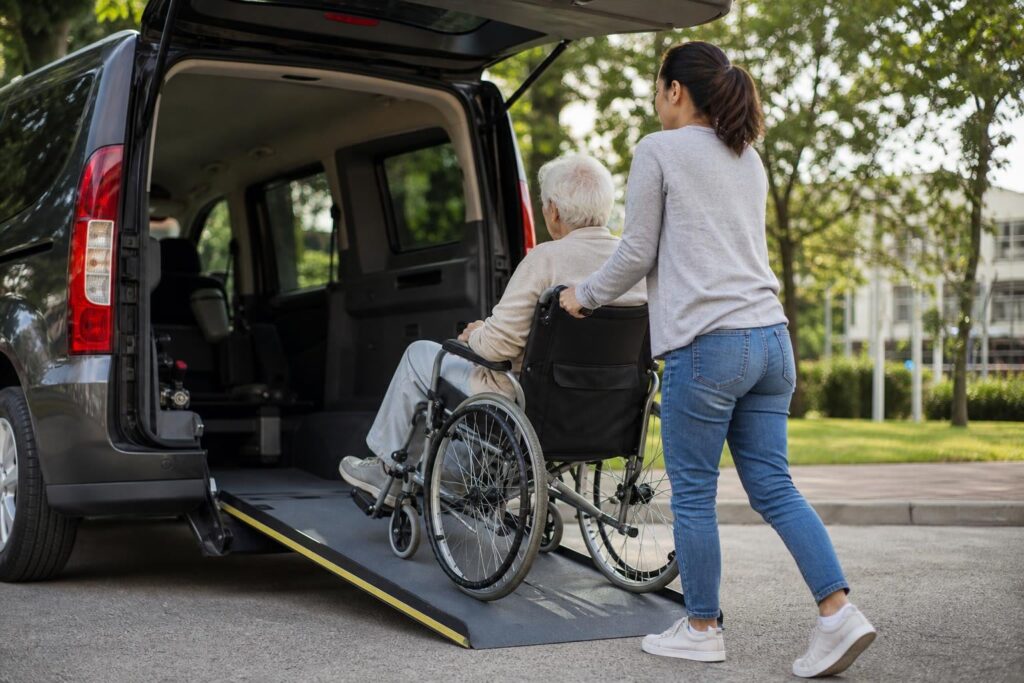
Wheelchair-accessible vans are fitted with ramps that provide step-free access. Ramps can be powered (deployed at the press of a button) or manual, and come in side-entry or rear-entry configurations. Side-entry ramps allow kerbside boarding, which is safer on busy streets. Rear-entry ramps require space behind the vehicle but are often wider.
Swivel Seat
An adaptive seat that rotates to face the door opening, allowing the passenger to sit down and then be swung into the forward-facing position. Swivel seats significantly reduce the twisting and shuffling that causes falls during vehicle entry.
Assist Bars and Grab Rails
Handles mounted near vehicle doors that give passengers something stable to grip while boarding or exiting. Some vehicles have them as standard; others can be retrofitted. For elderly passengers, the difference between having a grab rail and not having one can be the difference between a safe transfer and a fall.
Boot Space Requirements
This varies enormously. A folding cane needs almost nothing. A folding walker needs about 70 cm of boot depth. A power wheelchair may need the entire cargo area of a van. When booking transport, always specify what mobility aid you’re bringing and its approximate dimensions. If you’re transporting multiple family members with equipment, a larger vehicle like a V-Class or Sprinter is worth considering.
Safety and Securement Terminology
This section covers the terms that directly relate to preventing injury during transport. Some of these apply primarily to wheelchair-accessible vehicles, but the principles matter for anyone transporting elderly with mobility aids safely.
Four-Point Tie-Down System
The standard method for securing a wheelchair inside a vehicle. Four straps with locking mechanisms attach to the wheelchair frame: two at the front pulling forward and down, two at the rear pulling backward and down. Together, they prevent the chair from moving in any direction during travel, including in a collision.
WC19 Wheelchair
A wheelchair that has been crash-tested and certified for use as a vehicle seat. WC19 chairs have four clearly marked attachment points where tie-down hooks connect easily. If your loved one will regularly travel seated in their wheelchair (rather than transferring to a vehicle seat), a WC19-rated chair is the safest option.
Wheelchair Docking System
A newer alternative to strap-based tie-downs. The wheelchair user drives into a fixed position on the vehicle floor, and a bolt underneath the chair locks into a base plate. Docking systems allow wheelchair users to secure themselves independently, which preserves dignity and saves time. They’re increasingly common in modified private vehicles.
Occupant Restraint (Lap Belt, Shoulder Belt)
Even when a wheelchair is properly secured, the person sitting in it must also be restrained with a separate lap and shoulder belt. A 2016 report to NHTSA found that improper or incomplete use of these restraints is one of the main reasons wheelchair users are injured in vehicle crashes. Research indicates that up to 70% of wheelchair passenger injuries during transport are linked to incorrect belt adjustments. The belt must sit across the hips (not the stomach) and the shoulder (not the neck).
Stowed Mobility Aid
Any mobility aid that is stored in the vehicle during transport rather than being actively used. This is a safety concept that deserves more attention than it gets. In a documented case reviewed by the Justice Center, an elderly woman held her walker on her lap in front of her wheelchair during a van ride. When the driver braked suddenly, she was thrown forward into the walker because staff had not secured it separately.
The lesson: every mobility aid in the vehicle, whether it’s the passenger’s walker, a spare cane, or a folded wheelchair, must be secured so it cannot become a projectile during sudden stops or collisions.
Vehicle Transfer
The physical act of moving a person from a wheelchair (or standing position) into a vehicle seat, or vice versa. Safe transfers require planning, patience, and ideally training. Key principles include positioning the wheelchair as close to the vehicle seat as possible, locking the wheelchair brakes, and letting the passenger set the pace. Never pull someone by their arms, as this can cause shoulder injuries.
For more detail on transfer protocols in medical contexts, the guide on transporting medical patients safely covers the topic in depth.
Australian Legal and Regulatory Terms
Most online guides about transporting elderly with mobility aids safely are written for US audiences. Australian families need to know the local rules. Here are the key regulatory terms.
Disability Discrimination Act 1992 (DDA)
Australia’s national legislation that makes it unlawful to discriminate against people with disability in the provision of services, including transportation and access to premises. If a transport provider refuses to carry someone because they use a wheelchair or walker, that may constitute a breach of the DDA.
Disability Standards for Accessible Public Transport
These federal standards set specifications for mobility aids used on Australian public transport, including requirements for dimensions, manoeuvrability, and stability. In NSW, for example, a mobility aid must be able to turn 180 degrees within an area of 2,070 mm by 1,540 mm to be used on public transport. This matters because larger power wheelchairs or scooters may not meet these specifications, making private transport the only practical option.
Australian Design Rules (ADR) for Modified Vehicles
Vehicles modified to transport a wheelchair user must comply with strict safety and engineering requirements under Australian Design Rules. These ensure the vehicle remains structurally sound after modification and that wheelchair securement points are strong enough to hold in a crash. Any vehicle you see carrying a wheelchair passenger in Australia should have been certified under these rules.
NDIS Mobility Aid Funding
The National Disability Insurance Scheme provides funding for mobility aids based on individual needs. If your loved one is an NDIS participant, their plan may cover the cost of a wheelchair, walker, or modifications to a vehicle. It’s worth checking with their NDIS planner whether transport-related equipment falls within their funding.
Queensland and State-Specific Transport Guidelines
Queensland transport guidelines specifically state that drivers must give people using mobility aids, including wheelchairs, mobility scooters, walkers, canes, and crutches, priority to use allocated spaces. Similar obligations exist in other states. These rules apply to public transport operators, but they also set the standard of care that private transport providers should meet.
Transport Service Types: Knowing Your Options
When families start looking into transporting elderly with mobility aids safely, they usually discover three broad categories. Understanding the differences helps you pick the right one.
Kerb-to-Kerb Service
The driver picks up and drops off at the kerb. The passenger is responsible for getting from their door to the vehicle and from the vehicle to their destination door. For someone with limited mobility, that unassisted stretch can be the most dangerous part of the trip.
Door-to-Door Service
The driver assists from the passenger’s starting door all the way to the destination door. This includes help with steps, pathways, and building entrances. For elderly passengers with mobility aids, door-to-door service eliminates the most hazardous gaps in the journey.
Non-Emergency Medical Transport (NEMT)
Specialised transport for people who need to reach medical appointments but don’t require an ambulance. NEMT services provide trained staff and equipment like stretchers and oxygen. The trade-off: NEMT can be expensive, and for non-medical trips (visiting family, attending a funeral, going to lunch) it is often more than what’s needed.
Assisted Chauffeur Transport
This is the middle ground that most transport guides ignore entirely. A professional chauffeur service with trained, discreet drivers and suitable vehicles (sedans, SUVs, vans) that can handle mobility aids with care, without the clinical feel of a medical transport. Practitioners on senior care forums frequently note that elderly passengers are more willing to accept help when the experience feels dignified rather than institutional.
For trips like attending a memorial service, a medical appointment, or a family gathering, assisted chauffeur transport offers the safety of trained assistance with the comfort of a private car. Rideshare drivers, by contrast, typically have no training in elderly assistance, no obligation to help with boarding, and vehicles that may not accommodate mobility aids.
Rideshare Limitations
Standard rideshare services are designed for able-bodied passengers. Drivers aren’t trained in vehicle transfers, won’t typically help load a walker, and may refuse a wheelchair altogether. The vehicles are whatever the driver happens to own, with no guarantee of boot space or low entry height. For transporting elderly with mobility aids safely, rideshare should be considered a last resort. The benefits of using a professional chauffeur service become especially clear in this comparison.
Pre-Trip Communication Checklist
Multiple sources across the healthcare and transport sectors agree on one point: advance communication with the driver or service is the single most impactful safety measure families can take. Here’s what to communicate before booking.
What to Tell Your Transport Provider
- The specific mobility aid your loved one uses (type, whether it folds, approximate weight and dimensions)
- Any medical conditions that affect the trip: dementia, cardiovascular issues, diabetes, vertigo, recent surgery
- Assistance needed: help with steps, seatbelts, getting to the door, carrying bags
- Special equipment: oxygen tank, hearing aids (the driver should know to face the passenger when speaking), medications that need to stay at hand
- Pick-up logistics: is there a ramp at the house? Steps? A narrow doorway the wheelchair won’t fit through?
- Destination details: will someone meet the passenger? Does the building have accessible entry?
For airport transfers involving elderly passengers, add flight details so the chauffeur can monitor arrival times and adjust the pick-up accordingly, rather than having a frail person wait at the kerb.
Meet-and-Greet Protocol
A meet-and-greet means the driver meets the passenger at a specific point (airport gate area, front door, hospital entrance) with a name sign or pre-arranged contact. For elderly passengers who may be confused by busy environments, this removes the stress of finding their ride. The best transport providers share the chauffeur’s contact details before pick-up so the family can coordinate directly.
Practical Safety Tips for Families
Beyond understanding the terminology, there are everyday habits that prevent most transport injuries. None of these are complicated. They just require intention.
Allow extra time. Rushing is the enemy of safe transport. Build in an extra 15 to 20 minutes for boarding, loading the mobility aid, and settling in. When elderly passengers feel rushed, they skip safety steps: they don’t wait for assistance, they don’t hold the grab rail, they try to stand before the vehicle has fully stopped.
Check the mobility aid before travel. Brakes on a rollator should engage firmly. Tyres on a wheelchair should be properly inflated. Battery charge on a powerchair should be sufficient for the trip plus a buffer. A mobility aid that fails mid-transfer is a fall waiting to happen.
Secure everything in the vehicle. Every loose item, whether it’s a walker, a handbag, a water bottle, or a shopping bag, should be placed where it cannot fly forward during sudden braking. The projectile risk from unsecured items is real and well-documented.
Comfort supports safety. This is counterintuitive but important. Senior transport practitioners point out that comfort is not a luxury but a safety feature. An elderly person forced into an uncomfortable seat will lean forward, shift around, or try to adjust their seatbelt, all of which compromise their restraint position. Properly adjusted seats and belts keep the passenger both comfortable and safe.
Don’t hesitate to ask for help. Professional drivers who regularly handle elderly transport expect to assist. They won’t be annoyed by a request to help with a seatbelt or wait while someone gets settled. If the driver seems impatient or unwilling, that’s a sign you’ve booked the wrong service.
Follow up. After the trip, check in with your loved one. Did they feel safe? Was the driver helpful? Was the vehicle suitable? This feedback loop helps you refine future bookings and flag problems early.
More than a third (34%) of pedestrians killed in Victoria over a recent five-year period were aged 70 or older. Many of these deaths occurred in situations that better planning could have prevented. The stakes of getting transport right are genuinely high.
Frequently Asked Questions
Can a standard sedan transport someone with a wheelchair?
Yes, if the passenger can transfer from the wheelchair to the car seat. The wheelchair then folds and goes in the boot. Manual folding wheelchairs work well for this. Power wheelchairs generally don’t fold and are too heavy for a sedan boot, so you’ll need a van or SUV.
What should I do if my elderly parent’s mobility scooter doesn’t fit in the transport vehicle?
Contact the transport provider before booking and give them the scooter’s dimensions and weight. Many providers have larger vehicles (vans, minibuses) that can accommodate scooters, but these need to be arranged in advance. If the scooter disassembles, mention that too, though allow extra time for breakdown and reassembly.
Is it safer for a wheelchair user to transfer to the vehicle seat or stay in the wheelchair?
Transferring to a vehicle seat with a standard seatbelt is generally considered safer in a collision. Staying in the wheelchair is appropriate when a transfer isn’t physically possible, but requires a proper four-point tie-down system and a separate occupant restraint belt. A WC19 crash-tested wheelchair is strongly recommended if the person travels seated in their chair regularly.
Does the NDIS cover transport costs for elderly Australians with disabilities?
NDIS can fund mobility aids and, in some cases, vehicle modifications based on individual plans. Transport costs themselves may be covered under certain NDIS categories, but this varies by participant. Check with your NDIS planner or support coordinator for specifics.
What Australian laws protect elderly people with mobility aids during transport?
The Disability Discrimination Act 1992 prohibits discrimination against people with disability in transport services. The Disability Standards for Accessible Public Transport set specific requirements for public transport accessibility. Vehicles modified for wheelchair transport must meet Australian Design Rules for structural safety and securement.
How far in advance should I book transport for an elderly person with a mobility aid?
At least 24 to 48 hours is ideal. This gives the provider time to assign the right vehicle, brief the driver on specific needs, and confirm logistics. For regular appointments, setting up a recurring booking reduces the organisational burden and ensures consistency.
What’s the difference between non-emergency medical transport and a chauffeur service for elderly passengers?
NEMT is designed for people who need medical-grade equipment or trained medical staff during transport, think stretchers, oxygen, or patient monitoring. A professional chauffeur service offers trained drivers, suitable vehicles, and personal assistance without the clinical setup. For social outings, family visits, or routine appointments, chauffeur transport is often more appropriate and comfortable. Reach out to discuss specific needs if you’re unsure which option suits your situation.
Are rideshare services safe for transporting elderly people with walkers or wheelchairs?
Generally, no. Rideshare drivers aren’t trained in elderly assistance or vehicle transfers, and their vehicles aren’t selected for accessibility. There’s no guarantee of boot space, grab rails, or willingness to help. For anyone who depends on a mobility aid, a professional service with trained drivers and pre-arranged vehicle selection is substantially safer.