
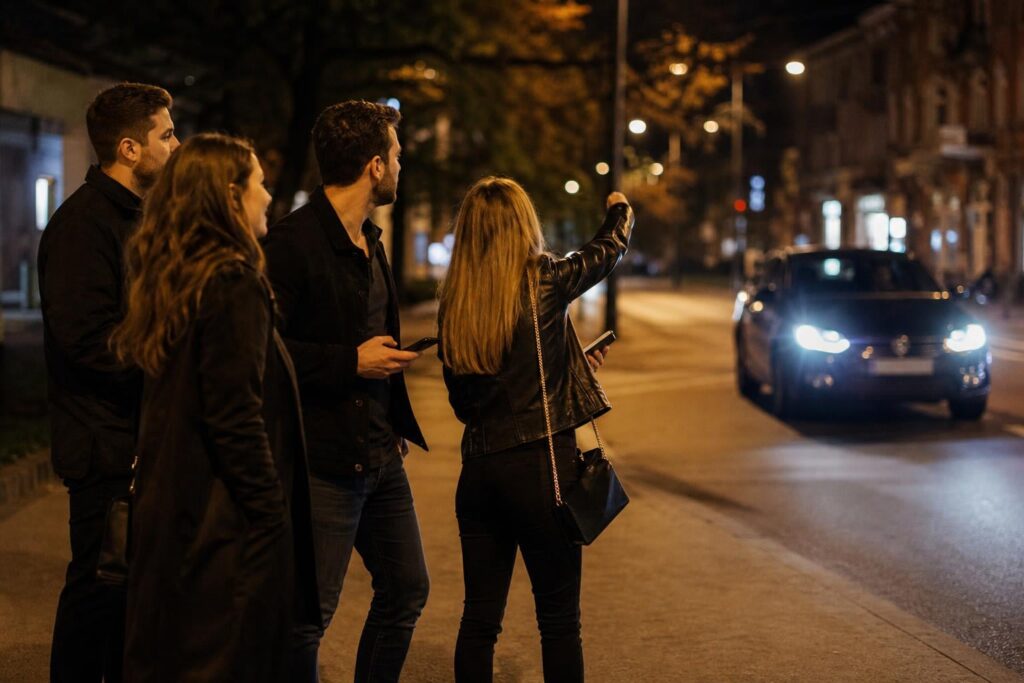
TL;DR: Groups fall apart after late-night events because public transport stops, rideshare prices surge, and nobody agreed on a plan. The fix is simple: designate a single meeting point, appoint a group leader, size your vehicle to fit everyone, and book fixed-price transport before the event starts. This glossary defines every term you need to make that happen safely.
Concerts, galas, formals, sporting finals. The event itself usually goes off without a hitch. It’s what happens afterward that falls apart.
People scatter. Phones die. Someone wanders off looking for a cheaper Uber four blocks away. Someone else decides to drive when they probably shouldn’t. What started as a group of ten celebrating together becomes five separate problems at midnight.
This is not a minor inconvenience. In Australia, 30% of all drink-driving fatalities occur between 9pm and 3am on Thursday, Friday, and Saturday nights. Keeping your group together after a late-night event is not just about logistics. It can be a safety decision with real consequences.
This glossary covers the key terms, concepts, and strategies every group organiser should understand when planning late-night transport. Whether you’re coordinating a school formal, a corporate gala, or a friends’ night at a concert, these definitions will help you build a plan that actually works.
Explore group transport options to see how pre-booked vehicles keep your entire party in one place.
Planning Concepts: The Foundation of Keeping Groups Together
These are the terms that matter before anyone sets foot in the venue. Getting these right is the single biggest factor in whether your group stays together or fragments at the end of the night.
Single Meeting Point
Definition: One predetermined pickup location, agreed on by all group members before the event, where everyone gathers at a specific time for departure.
This is the most important concept in this entire glossary. Event transport professionals consistently say the fastest way to improve group pickup reliability is not finding more cars. It’s reducing decision-making at the curb. One clear meeting point, one timing plan, and one shared communication thread beat a dozen individual messages.
Pick somewhere specific. “Outside the venue” is not a meeting point. “Under the blue sign at Gate C, on the left side of the road” is. Drop a pin in a group chat. Make sure everyone sees it before the event starts.
Warning signs your meeting point will fail: directions like “we’ll be outside” without specifying which entrance, no backup plan if the spot is blocked, and group members who haven’t confirmed they know where to go.
Departure Wave
Definition: A scheduled series of return trips at set intervals, designed for events where different people leave at different times.
Not everyone finishes at the same moment. At a gala, some guests leave after dinner, others after speeches, and a final group stays through the last dance. At a multi-act concert, some people skip the encore. Event planners recommend offering an initial departure after the main program, followed by a final late-night pickup.
This approach is particularly valuable when arranging transport for guests at multiple hotels, where staggered departures prevent long waits and keep each subgroup intact.
Buffer Time
Definition: Extra time added between the event’s advertised finish and the vehicle’s scheduled departure, accounting for networking, photos, bathroom queues, wardrobe changes, and the general slow drift toward the exit.
A concert might officially end at 11pm, but between the encore, the crowd clearing, and your group finding each other, you’re looking at 11:30pm minimum. Build in 15 to 30 minutes of buffer. Booking a pickup for the exact advertised end time virtually guarantees half your group won’t be there.
Return Plan
Definition: The pre-arranged transport schedule for getting the group home after the event, planned with the same attention as the outbound trip.
Here’s something event coordinators emphasize repeatedly: the return trip is harder than the outbound. Getting to the venue is easy because everyone is excited, on time, and headed to the same place. Coming home? People are tired, scattered across the venue, and often affected by alcohol.
A lot of events are well organised on the way in and chaotic on the way out. That happens because return transportation gets treated as a loose detail instead of a scheduled part of the experience. If you want to know how to keep a group together after a late-night event, the return plan is where most people fail.
Learn how to prepare a ride schedule when your group involves multiple pickup stops.
Group Leader / Transport Coordinator
Definition: One designated person who has the driver’s contact details, knows the meeting point, and takes responsibility for rounding everyone up at departure time.
This role is non-negotiable for groups larger than four. The group leader doesn’t need to be the organiser of the entire event. They just need to be the person who stays relatively sober, keeps their phone charged, and is willing to send the “we’re leaving in 10 minutes” text.
Setting clear meeting times with a buffer for latecomers and designating a group leader to coordinate with the chauffeur on the day is recommended across nearly every professional transport planning source.
Vehicle and Service Types: Choosing the Right Fit
Picking the wrong vehicle (or worse, no vehicle at all) is how groups get split across three different Ubers heading to three different suburbs. These terms will help you match your group size to the right transport option.
As-Directed Hire (Hourly Hire)
Definition: A vehicle and chauffeur booked for a block of time rather than a fixed route. The vehicle stays at your disposal for the entire period.
This is ideal when you genuinely don’t know when the event will end, or when the group might want to make stops on the way home. The driver waits, and you pay for the time block rather than a per-trip fare. It eliminates the stress of racing to meet a fixed pickup time.
Fixed-Price Transfer
Definition: A pre-agreed fare for a specific journey from point A to point B, locked in at the time of booking regardless of demand, traffic, or time of night.
This is the direct opposite of rideshare surge pricing, and it’s the single biggest cost advantage of pre-booking. When 20,000 people pour out of a stadium simultaneously, rideshare fares that were $15 before the show can hit $45 to $75 within minutes. A fixed-price transfer costs the same at midnight as it did when you booked it last Tuesday.
For a deeper comparison, see luxury transport vs rideshare and decide which model suits your group.
Stretch Limousine
Definition: An extended-wheelbase vehicle seating 6 to 14 passengers, designed for group travel in a single cabin.
The practical benefit here is not the luxury factor (though that helps). It’s that a stretch limousine physically keeps everyone in one vehicle. No splitting the group across multiple cars, no “which Uber did Sarah get into?”, no one left behind on the kerb. One vehicle, one departure, one arrival.
If you’re planning a school formal or birthday celebration, here’s a guide on how to book a stretch limousine for those occasions.
Minibus / Sprinter
Definition: A mid-capacity vehicle seating roughly 8 to 14 passengers, often used as the workhorse of group event transport.
For groups that are too large for a single sedan but don’t need (or want) a full stretch limo, a Sprinter-style minibus hits the sweet spot. It’s large enough to keep everyone together, compact enough to navigate city streets and venue pickup zones, and practical enough for corporate events where a stretch limo might feel out of place.
Surge Pricing / Dynamic Pricing
Definition: A rideshare pricing model where fares multiply during periods of high demand. After late-night events, surge multipliers of 2x to 5x are common within minutes of the event ending.
The worst sustained surge windows are Friday and Saturday nights from 9pm to 2am, with average multipliers of 2.4x to 3.1x and peaks above 5x near bar districts. This pricing model is the primary reason groups fragment after events. When the fare jumps from $15 to $60, people start making independent decisions: some walk, some wait, some leave alone.
Walking 4 to 6 blocks from the venue can reduce surge fares by 30 to 50%, but that strategy also splits the group, which defeats the purpose.
Standby Vehicle
Definition: A backup vehicle kept on call for VIPs leaving early, latecomers, or unexpected needs during an event.
Corporate event planners commonly use standby vehicles for speakers, executives, or guests who need to leave before the main departure. Without one, an early departure means either pulling the main vehicle away (stranding the rest of the group) or putting someone in a surged rideshare alone.
Safety and Coordination Terms
Late-night travel carries real risks. These terms connect the logistics of keeping a group together to the safety outcomes that actually matter.
Designated Driver Dilemma
Definition: The social tension created when one member of a group must abstain from drinking in order to drive everyone home.
Nobody wants to be the designated driver at a celebration. It changes their experience, often breeds resentment, and research shows it doesn’t always work: 14% of Australian nightlife attendees reported drink driving in the past three months, and the main reasons people gave for driving impaired were that it was the quickest (23%), they didn’t want to leave the car (20%), or it was the cheapest option (16%).
Pre-booked group transport eliminates the decision point entirely. Nobody has to choose between a good time and a safe ride home.
Surge Zone
Definition: The geographic area surrounding a venue where rideshare prices spike immediately after an event ends.
Surge zones can extend several blocks in every direction from a major venue. The standard advice to “walk away from the venue” before ordering a rideshare does reduce the fare, but it also means your group is now walking through unfamiliar streets late at night, which introduces its own risks, especially given that 87% of late-night public transport incidents involve verbal harassment or antisocial behaviour.
Meet-and-Greet Pickup
Definition: A service where the chauffeur waits at a pre-agreed spot (often with signage) and shares their direct contact details with the group leader beforehand.
This removes the most stressful part of the post-event experience: finding your ride. Instead of squinting at licence plates in a sea of headlights, the group leader has a phone number, a name, and a confirmed location. Learn more about how meet-and-greet pickups work in practice.
Post-Event Egress
Definition: The process of clearing attendees out of a venue and into their transport. One of the most chaotic windows of any event.
Music Victoria’s best-practice guidance for Australian venues recommends directing staff to manage patrons waiting for pickups, notifying taxi companies in advance of event finish times, and having a free phone available for patrons to call for transport. As a group organiser, you can’t control the venue’s egress process, but you can make sure your group knows exactly where to go when it starts.
Late-Night Incident Rate
Definition: The elevated risk profile of travel between 10pm and 5am, measured by safety incidents per journey.
In Australia, public transport incident rates during late-night hours climb to approximately 4.8 per 100,000 journeys. Female passengers report feeling unsafe 2.3 times more often than male passengers during these hours. These numbers aren’t reasons to panic, but they are reasons to have a plan rather than winging it.
Booking and Cost Terms
Understanding these terms prevents surprises on your invoice and helps you compare options accurately.
Security Bond
Definition: A refundable deposit (typically per vehicle) held against damage or policy breaches during event transport. Standard across professional limousine services.
This is normal practice and shouldn’t alarm you. A security bond protects both parties. As long as the trip goes smoothly, you get it back.
Cancellation Window
Definition: The timeframe within which cancelling a booking incurs partial or full charges. Knowing this upfront prevents disputes.
Always check cancellation terms before booking. If your event has any chance of being postponed or rescheduled, understanding the cancellation window saves you money and frustration. Check our chauffeur service pricing guide for what to expect on costs and booking terms.
Fare Split
Definition: Dividing a rideshare fare among passengers to reduce the per-person cost.
Fare splitting sounds cheap until surge pricing enters the equation. A surged Uber split four ways can easily cost more per person than each person’s share of a pre-booked stretch limo. This is where the maths consistently surprises people.
| Factor | Rideshare (Surged) | Pre-Booked Chauffeur |
|---|---|---|
| Late-night pricing | 2x to 5x surge multiplier | Fixed price at booking |
| Group cohesion | Split across multiple vehicles | Everyone in one vehicle |
| Wait times | Unpredictable after events | Driver already waiting |
| Post-midnight availability | Driver supply drops sharply | Confirmed regardless of hour |
| Safety | Algorithm-assigned driver | Known, vetted chauffeur |
The Drink-Driving Connection: Why This Matters More Than Convenience
No current competitor page connects keeping groups together to drink-driving prevention. But the data is impossible to ignore.
On Thursday, Friday, and Saturday nights, approximately 50% of road collisions involve alcohol. More than 60% of young Australian drivers in one survey admitted to potentially driving above the legal blood-alcohol limit the morning after an event, and 20% of drink-driving arrests occur the next morning.
The reasons people give for driving impaired are revealing: it was the quickest way, they didn’t want to leave the car behind, or it was the cheapest option. Every one of those reasons disappears when there’s a pre-booked vehicle waiting at a known location at a fixed price. Keeping your group together after a late-night event isn’t just about avoiding the “where are you?” texts. It removes the decision point where someone might make a dangerous choice.
Quick Reference: 7 Rules to Keep Your Group Together After a Late-Night Event
- Book the return trip before the event starts. The return is harder than the outbound. Don’t leave it to chance. Here’s a step-by-step booking guide if you’ve never booked a chauffeur transfer before.
- Designate a single meeting point. Be specific: gate number, landmark, side of the road. Drop a pin.
- Appoint one group contact who has the chauffeur’s direct number and takes responsibility for the headcount.
- Size the vehicle for the full group. Don’t split across cars. One vehicle, one departure.
- Share departure times with everyone before the event begins. Not at 11pm when the music stops.
- Add 15 to 30 minutes of buffer after the advertised end time.
- Choose fixed-price transport over surge-priced rideshare. The cost difference after a major event is often negligible, and sometimes the pre-booked option is cheaper.
Frequently Asked Questions
How do I keep a group together after a late-night event if some people want to leave early?
Use the departure wave approach. Schedule two or three pickup windows (for example, one after the main act and one 30 minutes after the event ends). If your budget allows, book a standby vehicle for early leavers so the main group isn’t disrupted.
Is pre-booked transport actually cheaper than rideshare after a concert?
Often, yes. Rideshare surge pricing after major events can reach 2x to 5x the normal fare. A pre-booked stretch limo or minibus at a fixed price, split among 8 to 12 people, frequently works out cheaper per person than individual surged rideshare trips.
What’s the best meeting point for a group after a late-night event?
Choose a well-lit, specific location away from the main crowd exit but still close enough that nobody has to walk far. Avoid vague descriptions. Use a gate number, a statue, a specific shop front, and always share a map pin in the group chat before the event.
How far in advance should I book group transport for a late-night event?
At least a week in advance for standard events. For major concerts, sporting finals, or New Year’s Eve, book as early as possible. Professional transport providers confirm availability and staging plans at booking, which means your plan is locked in while others are still hoping to find an Uber at midnight.
What if plans change on the night?
This is where as-directed (hourly) hire shines. Because the vehicle is booked for a time block rather than a fixed route, you have flexibility to adjust pickup times or locations. Having the chauffeur’s direct contact number means changes can be communicated in real time.
How many people can fit in a stretch limousine?
Stretch limousines typically seat 6 to 14 passengers depending on the specific vehicle. This makes them practical for friend groups, bridal parties, and school formal cohorts who want to travel together rather than splitting across multiple cars.
Does keeping the group together actually improve safety?
Yes. Late-night incident rates on Australian public transport are significantly higher than daytime rates, and individuals travelling alone face greater risk. A group in a pre-booked vehicle with a professional chauffeur avoids walking through surge zones, waiting on dark streets, and the temptation for someone to drive when they shouldn’t.
What is a transport coordinator and do I really need one?
A transport coordinator is the one person in your group who has the driver’s number, knows the meeting point, and sends the “time to go” message. For any group over four people, this role is essential. Without it, you get ten people making ten separate decisions at midnight, which is exactly how groups fall apart.
Ready to lock in your group’s return plan? Get a quote for your group and secure fixed-price transport that keeps everyone together, no matter how late the night runs.