
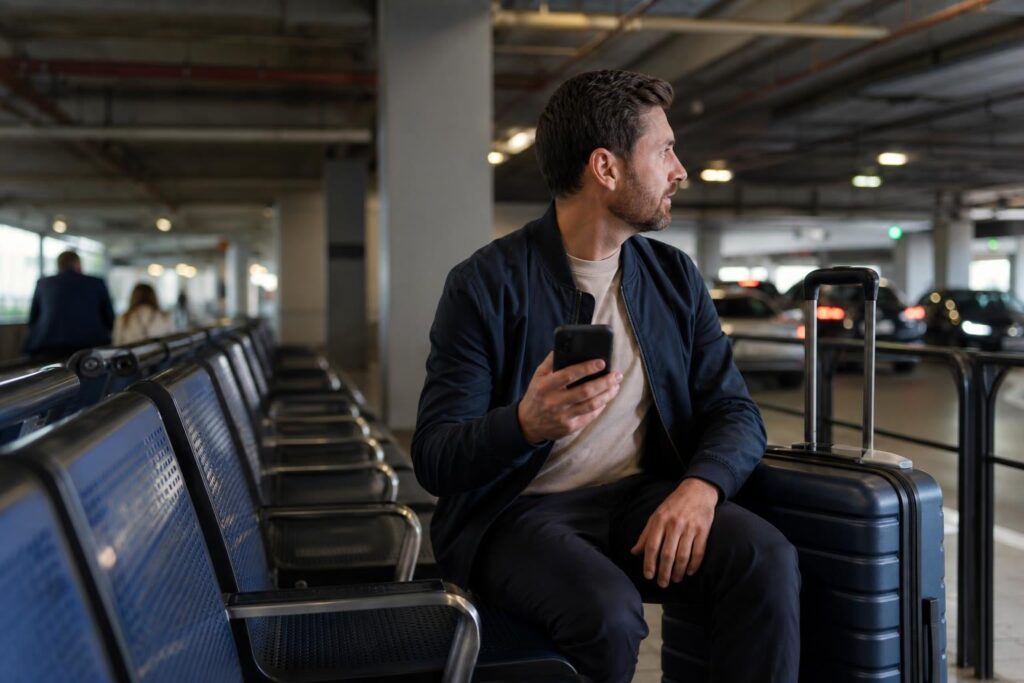
TLDR: Meeting someone at busy airport arrivals is a coordination problem, not a waiting problem. The pickup kerb is for loading, not lingering. Wait in a legal waiting area or car park until the passenger confirms they have their bags and are standing at the correct pickup zone. For international guests, elderly travellers, VIPs, or anyone who shouldn’t navigate a crowded terminal alone, book a professional meet-and-greet service.
The arrivals kerb at a busy airport looks like a meeting point. It is not. It is a loading point. Kerbside officers will move you on, free pickup windows run as short as six minutes, and your arriving passenger might still be waiting at the baggage carousel 30 minutes after the plane touched down.
The stress of figuring out how to meet someone at busy airport arrivals comes from a gap between expectation and reality. Most people picture themselves pulling up just as the passenger walks out the doors. What actually happens: you circle the terminal, get waved on by staff, lose phone signal in a car park, and spend 20 minutes trying to describe where you are while traffic banks up behind you.
This guide explains how the arrivals process actually works at Australian airports, where to wait, when to move, and when a professional chauffeur meet-and-greet is the smarter option.
Explore private airport transfers with meet-and-greet.
What Does It Mean to Meet Someone at Airport Arrivals?
Meeting someone at airport arrivals means arranging a clear handoff after the passenger leaves the secure area, collects any baggage, and reaches either the public arrivals hall or the designated passenger pickup zone. The driver should not wait at the kerb. They should wait legally nearby and enter the pickup area only when the passenger is ready.
This sounds simple. In practice, three things make it hard:
-
Airports use different names for the same zones. Sydney has “Public Pick-up” and “Express Pick-up.” Brisbane has “Passenger Pick-Up.” Melbourne has a “Wait Zone.” Cairns has a “Standby Zone.” If you tell someone “meet me at arrivals,” you haven’t actually told them anything useful.
-
Landing time does not equal ready time. A plane can land at 2:15 pm, but the passenger might not clear baggage until 2:40 and might not exit customs until 3:10.
-
Pickup zones enforce strict time limits. Brisbane Airport’s domestic kerbside zone is strictly for passengers ready immediately, and drivers may be moved on by kerbside officers if the passenger is not there. Perth Airport gives you just six minutes free at express areas before overstay fees kick in.
If you’ve been confused about international arrivals meeting points, you are not alone. The terminology trips up even frequent travellers.
Quick Answer: The Safest Way to Meet Someone at Busy Arrivals
If you need the short version, here it is:
- Get the flight number, airline, terminal, and the passenger’s mobile number.
- Check the airport’s official arrivals page for flight status.
- Ask whether they have checked bags or carry-on only.
- Agree on the exact pickup zone name, door number, or bay.
- Wait in a legal waiting area, standby zone, or short-term car park.
- The passenger texts or calls after collecting bags and clearing any customs or biosecurity.
- Drive into the pickup zone only when they are ready at the kerb.
Gold Coast Airport recommends allowing 10 to 15 minutes after landing for passengers to collect luggage before you arrive for pickup. Practitioners on Reddit echo the same rule: wait until the person has their bags and is physically at the pickup zone before driving in.
That framework works for a capable adult on a domestic flight with a working phone. For anything more complicated, keep reading.
Airport Arrivals Glossary
Part of the confusion around how to meet someone at busy airport arrivals is vocabulary. Here are the terms that actually matter, explained plainly.
| Term | What it means | Why it matters |
|---|---|---|
| Arrivals hall | The public area where arriving passengers appear after baggage claim (domestic) or after immigration, baggage, customs, and biosecurity (international) | This is where face-to-face greetings happen. Chauffeurs with name signs wait here. |
| Baggage claim / reclaim | Where checked luggage is collected | The passenger is not ready when the plane lands. They are ready after this step. |
| Customs / biosecurity exit | The point after international clearance processes | Timing here is unpredictable. Greeters wait beyond this point, not inside the controlled area. |
| Passenger pickup zone | Roadside area for immediate vehicle loading | Not a waiting area. You load bags and leave. |
| Express / Public pickup | Short-stay pickup option with a free window (often 6 to 15 minutes) | Good only when passenger is already kerbside |
| Rideshare zone | Separate area for app-based rides (Uber, Didi, etc.) | Not the same as public or chauffeur pickup. Tell the passenger which zone to use. |
| Short-term parking | Paid or free-short-period car park near the terminal | Best option for meeting inside the terminal |
| Wait Zone / Standby Zone | Legal place to wait in your car until the passenger calls | Reduces circling, kerbside stress, and fines |
| Meet-and-greet | A pre-arranged service where a chauffeur or greeter meets the passenger at the arrivals exit, often with a name sign, helps with luggage, and escorts them to the vehicle | Best for VIPs, families, elderly travellers, and international arrivals |
The Three-Zone Model for Busy Airport Arrivals
Most guides list steps without explaining why airport pickups go wrong. This simple mental model helps.
Zone 1: Secure or Controlled Area
This includes gates, immigration halls, customs, biosecurity, and some baggage areas. The person meeting the passenger usually cannot access this zone. Security screening is compulsory for anyone entering secure areas of Australian airport terminals. A chauffeur or family member cannot simply walk past security to collect someone.
For international arrivals, the Australian Border Force requires passengers to complete an Incoming Passenger Card covering identity, flight details, customs declarations, and biosecurity questions. The Department of Agriculture notes that airport infrastructure and baggage transfer arrangements can influence how long passengers take to move through baggage reclaim and inspection. This is why international arrival timing is genuinely unpredictable.
Zone 2: Public Arrivals Hall
This is where the passenger becomes visible to the public. It is the best place for a face-to-face greeting, a name sign, or a calm handoff. Adelaide Airport explicitly states that international arrivals should be met in the arrivals hall after customs and immigration, while the pickup zone outside is for curbside pickup only.
If you want to greet someone inside, park in short-term parking. Do not leave your car in the pickup lane.
Zone 3: Vehicle Pickup Zone
This is where the handoff finishes, not where the waiting begins. Vehicles must keep moving. Brisbane International allows up to 10 minutes free in the Passenger Pick-Up area, but drivers should remain with the vehicle and may be asked to move on if the passenger is not ready. Cairns Airport states that no waiting or parking is permitted in pickup zones, and passengers must be waiting kerbside for immediate pickup.
Understanding these three zones is the key to meeting someone at busy airport arrivals without stress.
Step-by-Step: How to Meet Someone at Busy Airport Arrivals (DIY)
Step 1: Collect the Right Details Before the Flight
Before the passenger boards, get:
- Flight number and airline
- Arrival airport and terminal (if known)
- Domestic or international flight
- Checked bags or carry-on only
- Passenger’s mobile number (with country code for international)
- Whether they have roaming or a local SIM
- Any accessibility needs
- Luggage size and count
This checklist is the same information a professional chauffeur needs. If you want to learn more, see how to prepare for a chauffeur pickup at major Australian airports.
Step 2: Check the Airport’s Official Page, Not Just Google Maps
Airport pickup rules change. Roadworks reroute traffic. Terminals swap airlines seasonally. Melbourne Airport has major pickup and drop-off changes scheduled under the Naarm Way project, with a new T123 Transport Hub planned to provide dedicated pickup and drop-off zones. The Wait Zone on Mercer Drive is currently free for the first 60 minutes, but the layout is evolving. Always check the airport’s current pickup page before you travel.
Step 3: Choose Your Meeting Method
Three options, each suited to different situations:
Curbside pickup. Fastest and cheapest. Works when the passenger is independent, has a working phone, and can stand at the correct pickup zone with bags ready. You pull in, load, and go.
Park and meet inside. Calmer and better for emotional reunions, elderly relatives, passengers with children, first-time visitors, and anyone without phone access. Park in short-term parking, walk to the arrivals hall, and meet face-to-face.
Professional chauffeur meet-and-greet. Best for VIPs, corporate travellers, international guests, groups, and passengers who should not have to find a car alone after a long flight. The chauffeur tracks the flight, waits with a name sign, helps with luggage, and walks the passenger to the vehicle.
Step 4: Wait Legally
Use the airport’s designated waiting area, standby zone, or short-term car park. Do not circle the terminal or stop on the approach road.
Brisbane Airport lists several waiting options including Domestic ParkShort, the Brisbane Airport Service Centre, Kingsford Smith Memorial, and Skygate, some offering free parking for up to two hours. Cairns Airport has a Standby Zone with up to 30 minutes free. Even Newark Liberty International Airport posts on social media telling drivers to use the free cell phone wait lot while passengers collect baggage.
Practitioners on Reddit consistently offer the same advice. One user in r/ExplainLikeImScared recommended waiting in the airport waiting area, tracking whether the person has checked bags, and having them text only after retrieving luggage and reaching the pickup zone.
Step 5: Passenger Confirms They Are Ready
The passenger should send a specific message, not “I’ve landed” but something like: “I have my bags and I’m at Public Pick-up, Zone B, outside Door 3.”
Use the landing time to start watching the flight. Use the “I have my bags” message to start driving into the kerb.
Step 6: Enter, Load, Leave
Pull into the next safe bay. Stay with the car. Load luggage. Leave promptly. This is not the place for extended hellos. Save that for the car or for the arrivals hall if you parked and walked in.
One Reddit user in r/driving shared that during their first airport pickup, they missed the arrivals turnoff, ended up at departures, and had to loop back. They described it as stressful but manageable. Missing a turn is normal. Airports are designed as loops. Follow signs and go around again rather than stopping illegally or panicking.
Should You Park and Go Inside?
This decision depends on who you are meeting, not on what is easiest for you.
| Situation | Best option | Why |
|---|---|---|
| Frequent domestic traveller, carry-on only | Curbside pickup | Fast and simple |
| Passenger has checked bags | Wait for bag confirmation, then curbside | Avoids overstay and looping |
| First-time visitor to the city | Park and meet inside, or chauffeur meet-and-greet | Reduces confusion |
| International arrival | Meet in arrivals hall or use meet-and-greet | Customs and biosecurity timing varies |
| Elderly passenger | Park and meet inside, or chauffeur meet-and-greet | Less walking, less stress |
| Family with kids and stroller | Park and meet inside, or chauffeur meet-and-greet | More hands for luggage and children |
| VIP, client, or executive | Professional meet-and-greet | Better first impression, less risk |
| Large group | Pre-book chauffeur, van, or minibus | Avoids multiple cars and luggage chaos |
| Passenger has no phone or roaming | Park and meet with a fixed landmark | Reduces missed connection risk |
For elderly travellers arriving at an unfamiliar airport, the pickup decision is really a safety decision. Read more about transporting elderly passengers safely.
What Is Airport Meet-and-Greet?
Airport meet-and-greet is a pre-arranged arrival handoff where a chauffeur or greeter:
- Tracks the flight in real time
- Waits at the agreed public arrivals point
- Holds a name sign if appropriate
- Confirms the passenger’s identity
- Helps with luggage
- Escorts the passenger directly to the vehicle
A common misconception is that meet-and-greet means the chauffeur can enter immigration, customs, or biosecurity areas. It does not. For international arrivals, the meeting normally happens after the passenger exits the controlled arrivals process and enters the public arrivals hall.
As one chauffeur industry practitioner noted on LinkedIn, meet-and-greet is not a luxury add-on. It is an operational advantage: the greeter tracks the flight, meets at the correct arrival point, helps with luggage, and coordinates vehicle access. Another operator on LinkedIn emphasized that airport collections should never rely on assumptions, and that the correct meeting position matters more than a generic instruction to “go to arrivals.”
Book a private airport transfer with meet-and-greet.
Luxury Limousine Chauffeurs offers airport transfers with meet-and-greet, chauffeur contact shared before pickup, real-time flight monitoring, and fixed-price single journeys. The fleet spans premium sedans, SUVs, vans, minibuses, and stretch limousines, covering cities including Brisbane, Sydney, Melbourne, Adelaide, Perth, Canberra, Darwin, Cairns, and the Gold Coast.
For readers weighing whether to handle pickup themselves or book a service, here is a practical guide to choosing an airport transfer company.
Australian Airport Pickup Quick Reference
Rules vary by airport and change over time. This table captures key facts as of mid-2025. Always check the airport’s official page before travelling.
| Airport | Key pickup fact |
|---|---|
| Sydney | T1 Public Pick-up and T2/T3 Express Pick-up offer up to 15 minutes free, one entry per calendar day. Use short-term parking to meet inside. |
| Brisbane International | Passengers follow green signage from Arrivals Hall to Passenger Pick-Up on Level 1. Drivers can wait up to 10 minutes free but may be moved on if passenger is not ready. |
| Brisbane Domestic | Kerbside is strictly for immediate pickup/drop-off. ParkShort first 15 minutes free. AIRPARK up to 1 hour free. |
| Melbourne | Wait Zone on Mercer Drive free for first 60 minutes. Pickup/drop-off arrangements changing in late 2026 under the Naarm Way project. |
| Perth | Express areas outside terminals. T2 and T3/4 offer up to 6 minutes free before overstay fees apply. ShortTerm parking and 1-hour free options available. |
| Adelaide | If passenger is not kerbside, exit and re-enter. Unattended vehicles may be towed. International arrivals can be met in arrivals hall after customs/immigration. |
| Canberra | Free 10-minute pickup in RED Outdoor Car Park. Express Pickup in GREEN Indoor Car Park. Private vehicles cannot pick up kerbside immediately outside terminal. |
| Gold Coast | Pickup/drop-off at front of terminal. Immediate pickup only. Allow 10 to 15 minutes after landing for luggage. |
| Cairns | Public pickup outside T1/T2. No waiting permitted. Standby Zone offers up to 30 minutes free. |
Sydney Reddit users frequently mention confusion between express/public pickup zones and priority/rideshare zones. One thread specifically warned drivers to distinguish between the yellow express pickup and the green priority area. For Sydney-specific tips, see this guide to Sydney airport transfers.
Australia’s busiest airports handle enormous passenger volumes. BITRE recorded Sydney, Melbourne, and Brisbane as the top three Australian airports for RPT passenger movements in the year ending June 2025, with Sydney alone at over 25 million domestic passengers. When arrivals areas handle traffic at that scale, vague pickup plans fall apart.
Text Message Templates for Airport Pickup
No ranking page currently provides usable pickup scripts. These fill a real gap.
Template 1: DIY Curbside Pickup
“When you land, don’t come outside straight away. Collect your bags first. Then follow signs to Public Pick-up (or Passenger Pick-up), not Rideshare or Taxi. Text me the terminal, door number, and zone when you are there. I’ll drive in then.”
Template 2: International Arrival
“After passport control, baggage, customs, and biosecurity, exit into the public arrivals hall. If you can message, send me a photo of the pickup zone sign or the door number. If your phone doesn’t work, go to [agreed landmark] and wait there. I’ll park and walk in.”
Template 3: Chauffeur Meet-and-Greet
“Your chauffeur will monitor the flight and meet you at the arrivals exit with your name sign. You’ll receive chauffeur contact details before pickup. If you don’t see them immediately, stay in the arrivals hall and call or message the contact number.”
Template 4: No Phone Backup
“If your phone doesn’t connect after landing, go to the information desk [or named café, arrivals board, etc.]. Wait there for 20 minutes before moving. Do not go to rideshare or taxi unless we agreed that as the backup.”
Common Mistakes When Meeting Someone at Busy Airport Arrivals
Arriving when the plane lands. The landing time is not the ready-for-pickup time. Taxiing, disembarking, walking through the terminal, baggage reclaim, border checks, biosecurity, and toilet stops all add up. A Reddit thread about international pickup timing noted that customs alone can take anywhere from 20 minutes to over an hour.
Waiting at the kerb. Airports actively discourage this. Use a waiting area, standby zone, or short-term car park instead.
Saying “I’m outside” and nothing else. “Outside” could mean any of six different zones. Use the exact terminal name, pickup type, door number, bay letter, or colour-coded zone.
Confusing rideshare with public pickup. Rideshare zones are often in a completely different location. Tell the passenger which type of pickup to follow signs for.
Forgetting international delays. Immigration, baggage, customs, and biosecurity create variable and sometimes long wait times. Do not guess. Wait for confirmation. For complex international arrivals, a flight-monitored chauffeur service removes the guesswork. Read more about planning pickup for international flights.
Making vulnerable passengers navigate alone. Elderly relatives, first-time visitors, passengers with limited English, or families with young children should not be left to find a car in a busy pickup lane. Park and meet inside, arrange airport assistance, or book professional meet-and-greet.
Not planning for phone failure. International phones may not have roaming. Batteries die. SIMs don’t activate. Always agree on a no-phone meeting point and a backup time before the flight.
When a Chauffeur Meet-and-Greet Is Worth It
Meet-and-greet is worth it when the cost of confusion is higher than the cost of the service.
The strongest use cases:
- International arrivals, especially first-time visitors to Australia
- Corporate executives and VIP clients
- Elderly travellers arriving alone
- Families with children and heavy luggage
- Groups arriving together who need a van or minibus
- Late-night or early-morning arrivals when patience is low
- Passengers with limited English or no local phone connection
- Anyone arriving for a wedding, cruise, conference, or critical meeting
For group arrivals with significant luggage, a single pre-booked vehicle is far less chaotic than multiple private cars trying to coordinate at the kerb. Luxury Limousine Chauffeurs offers vehicles ranging from sedans to group transport vans and minibuses to match the passenger count and luggage load.
Corporate travel managers booking executive pickups benefit from fixed-price airport transfers that remove surge pricing uncertainty.
Frequently Asked Questions
Where do I meet someone at airport arrivals?
Usually in the public arrivals hall, at the baggage claim exit, or at the airport’s designated passenger pickup zone. For curbside pickup, agree on the exact terminal, door, bay, or zone before the passenger comes outside. Saying “arrivals” is too vague at most Australian airports.
Can I wait at arrivals in my car?
Usually not for long. Most Australian airports restrict pickup zones to immediate loading only. Brisbane, Cairns, Gold Coast, Perth, and Canberra all publish rules that discourage or prohibit waiting at the kerb. Use a waiting area or short-term car park instead.
How long after landing should I pick someone up?
For domestic flights with checked bags, start monitoring when the plane lands but wait for the passenger to confirm they have their luggage. Gold Coast Airport suggests allowing 10 to 15 minutes after landing. International arrivals can take much longer because border processing, baggage, customs, and biosecurity timing varies.
Should I go inside the airport to meet someone?
Go inside if the greeting matters, the traveller is elderly or unfamiliar with the airport, they have no reliable phone access, or they are arriving on an international flight. Park in short-term parking rather than leaving your car in the pickup lane.
What is the difference between meet-and-greet and airport assistance?
Airport or airline assistance usually relates to mobility support, boarding, disembarking, or terminal navigation. Chauffeur meet-and-greet is the handoff from the public arrivals area to the vehicle. It does not bypass immigration, customs, biosecurity, or security screening.
What if the passenger’s phone does not work?
Agree on a fixed public landmark before the flight, such as the information desk, a large arrivals board, or a named café. Set a backup rule: if there is no message within a set time, the passenger waits at that landmark and the driver parks and walks in.
Should I use a name sign?
Use a name sign if the passenger does not know the driver, if you are meeting a corporate guest, if the airport is crowded, or if the arrival is international. For privacy, use a surname, company name, or agreed wording rather than unnecessary personal details.
What details does a chauffeur need for an airport pickup?
Passenger name, flight number, airline, arrival airport, terminal, mobile number with country code, luggage count, accessibility needs, destination, preferred sign name, and whether the passenger wants meet-and-greet or curbside pickup. To discuss specific requirements, contact the team with your flight and pickup details.