
TL;DR
Getting an elderly relative to a hospital appointment safely involves more than just the drive. It requires planning around mobility, fall risk, vehicle suitability, waiting times, and post-procedure needs. Australian families have several transport options, from government-subsidised community transport through My Aged Care to private chauffeur services with fixed pricing. This guide defines every key term caregivers encounter and lays out a clear decision framework for choosing the right option.
When an elderly parent or relative stops driving, the question of how to get them to medical appointments becomes urgent. Over 40% of older adults depend on family, friends, or neighbours for rides to appointments, according to transport barrier research. In Australia, the challenge is compounded by sprawling hospital precincts, limited parking, and a confusing mix of government programs that most families only discover after a crisis.
This guide explains every term you’ll encounter when arranging safe hospital transport for an elderly relative. It covers service levels, Australian funding pathways, safety preparation, and the practical questions most caregivers forget to ask.
If you need a professional, pre-booked solution with fixed pricing and door-to-door assistance, explore medical transfer options available across Australian cities.
Transport Service Levels: What Do They Actually Mean?
The difference between transport service levels is one of the most important things to understand when getting an elderly relative to a hospital appointment safely. These terms show up on provider websites, but most caregivers don’t know what they mean in practice.
Curb-to-Curb Service
In a curb-to-curb service, the driver waits outside the pickup location (typically at the curb) and the passenger makes their own way to the vehicle. Think of it like a standard taxi or rideshare pickup. The driver’s responsibility begins and ends at the vehicle.
When it works: For elderly people who are mobile, steady on their feet, and comfortable navigating a footpath or driveway independently.
When it doesn’t: For anyone using a walker, wheelchair, or who has balance issues. The gap between the front door and the vehicle is where falls happen most often.
Door-to-Door Service
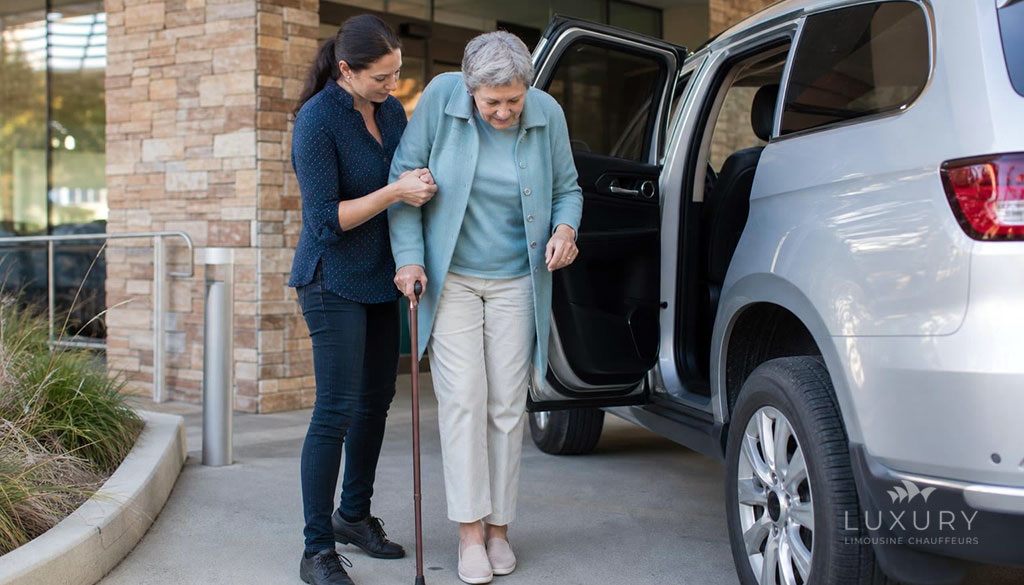
Door-to-door transport means the driver comes to the door of the home, assists the passenger to the vehicle, and then walks them from the vehicle to the door of the destination. It’s a significantly better option for elderly people with mobility aids or unsteady gait.
Why it matters: A frail person navigating a steep driveway, uneven path, or hospital ramp alone is a fall risk. Door-to-door service closes that gap.
Door-Through-Door Service
This is the highest level of assistance. The driver enters the home, helps the passenger prepare to leave, assists them into the vehicle, and at the destination walks them through the entrance and to where they need to be. This level of care is necessary for bed-bound patients requiring stretcher transport, or for someone who simply needs extra help getting out of the house safely.
Who needs it: People with severe frailty, advanced dementia, or those recovering from a fall who need physical support throughout the entire journey.
Understanding these distinctions matters because the most dangerous moment in the entire trip is often the short walk between the front door and the car. Research shows that fall injury risk spikes in the periods just before and after hospitalisation, making every step of the journey a safety consideration. When you understand the benefits of fixed-price chauffeur transport, you can see why predictable, assisted service beats a metered taxi for vulnerable passengers.
Transport Options Available in Australia
Australian families have more choices than they typically realise. Here’s a clear breakdown of each option, with honest assessments of what works and what doesn’t.
Driving Them Yourself
The most common solution. Over 40% of older adults rely on family for transport to medical appointments. It works when your car can accommodate their mobility aids, when you can take time off work, and when you’re comfortable navigating hospital parking.
It stops working when appointments are frequent (weekly dialysis, fortnightly specialist visits), when your car doesn’t suit their needs (low-slung sedans are difficult for people with hip replacements), or when the emotional weight of being the sole transport provider leads to burnout. As multiple caregiving resources note, relying solely on family members for consistent transport can lead to missed appointments and gaps in necessary medical care.
Community Transport (CHSP)
The Commonwealth Home Support Programme funds subsidised transport to medical appointments through over 1,300 providers across Australia. You access it through My Aged Care, which involves an assessment to determine eligibility. The service may come as a volunteer driver, community bus, or transport voucher.
The catch: Community transport typically operates Monday to Friday for appointment times between 9am and 4pm, excluding public holidays. All transport depends on volunteer driver availability. This means early-morning specialist appointments, late-afternoon sessions, or anything on a weekend are usually not covered. You also need to book well in advance, and cancellations from the provider side do happen.
Australian Red Cross Transport
The Red Cross provides transport specifically for hospital and medical appointments. You don’t need a My Aged Care registration, but you do need a referral from your doctor or specialist. In South Australia, Tasmania, and Victoria, the service is also available for people under 65.
Best for: People who haven’t yet navigated the My Aged Care system but need transport soon.
Non-Emergency Patient Transport (NEPT)
NEPT is for patients who need medical care or clinical monitoring during travel, but not an emergency ambulance. In Victoria, for example, the patient must meet three criteria: the transport must be clinically necessary, the patient must require clinical monitoring or care during transport, and an appropriate health professional must authorise it. This is regulated state by state through bodies like Ambulance Victoria.
Best for: Patients transferring between hospitals, those requiring oxygen or stretcher transport, or post-surgical patients with clinical needs during the journey.
Not suitable for: The vast majority of routine appointments where the patient is medically stable but simply frail or mobility-limited.
Taxi or Rideshare
Taxis and services like Uber are convenient and widely available. But they have real limitations for elderly passengers. Rideshare requires a smartphone, and drivers are not trained to meet the specific needs of elderly or disabled passengers. There’s no assistance getting in or out of the vehicle, no guarantee the driver will wait during the appointment, and no consistency (you’ll get a different driver every time).
Taxis can be somewhat better, particularly wheelchair-accessible taxis (WATs), but they often charge higher rates and availability of WATs can be limited, especially in regional areas.
Private Chauffeur Service
A private chauffeur service sits between the convenience of a taxi and the clinical focus of NEPT. The driver is pre-booked, pricing is confirmed in advance with no surge fees, and the vehicle and driver are consistent for recurring appointments.
For families getting an elderly relative to a hospital appointment safely, the key advantages are: the driver can provide door-to-door assistance, wait during the appointment (no frantic rebooking when the specialist runs 40 minutes late), and handle the hospital drop-off zone and parking logistics so the carer can focus entirely on the patient.
This is particularly valuable for recurring specialist visits, chemotherapy sessions, or appointments where the family carer is coordinating from interstate or overseas. You can view vehicle options to find something comfortable and suitable for your relative’s mobility needs. If multiple family members want to accompany the patient, group transport options are also available.
Safety Preparation: A Glossary of What to Know Before the Trip
Getting your elderly relative to a hospital appointment safely isn’t just about the vehicle. It’s about preparation, timing, and anticipating problems.
Pre-Appointment Checklist
Before leaving the house, make sure you have:
- Medicare card and any private health insurance details
- A current medication list (or bring all medications in their original packaging)
- Mobility aids: walker, cane, wheelchair
- Glasses and hearing aids
- Comfortable, well-fitting, flat, non-slip shoes (not loose slippers)
- A fully charged mobile phone
- Proper identification
- A list of questions for the doctor
- Snacks and water for potential waiting time
Having your chauffeur’s contact details before pickup reduces anxiety for both the passenger and family. Learn how to request contact details in advance so everyone knows who’s coming and when.
Fall Risk
Falls are the leading cause of injury-related hospitalisation for older Australians. The risk doesn’t just exist in the hospital, it’s present at every transition point: getting out of bed, walking to the car, entering and exiting the vehicle, navigating the hospital entrance, and returning home tired after the appointment.
A retrospective cohort study found pronounced spikes in fall injury risk in the periods immediately before and after hospitalisation. For many older people, there are also psychological impacts such as fear of falling, which can make them hesitant or rigid in their movements, ironically increasing the risk.
Practical mitigation: Choose door-to-door transport. Make sure the vehicle has a high enough seat that the person doesn’t have to lower themselves into it. SUVs and vans are generally easier than sedans. Allow extra time so nobody is rushing.
Waiting Time and Appointment Overruns
Hospital appointments rarely run on schedule. A 10am specialist appointment might not actually happen until 10:45. This matters because whoever is providing transport needs to either wait or be available to return at short notice.
Taxis and rideshares don’t wait. Community transport volunteers may have other pickups scheduled. A pre-booked chauffeur with an hourly or wait-time arrangement handles this seamlessly. For tips on managing timing uncertainty, read about ensuring on-time arrival for important appointments.
Post-Procedure Transport
After sedation, day surgery, anaesthesia, or even a distressing consultation, the return trip is a different challenge. The patient may be groggy, emotional, nauseous, or in pain. They might need to recline, they definitely shouldn’t be standing at a taxi rank, and they may not be able to communicate clearly with a rideshare driver.
Post-procedure transport needs a driver who is prepared to wait, who won’t rush the patient, and who can adjust the journey if the patient needs to stop.
Companion During the Appointment
For elderly relatives with cognitive decline or dementia, having a companion remain at the doctor’s office during the visit is not optional, it’s essential. Being left alone in an unfamiliar environment can cause agitation, confusion, or wandering. As soon as the appointment is done, the companion should be ready to guide them back to familiar, safe transport.
Even for cognitively intact elderly people, having someone present to take notes, ask follow-up questions, and remember instructions the patient might forget is invaluable.
Hospital Parking and Drop-Off Logistics
Australian hospital precincts are notoriously complex. Multi-story car parks with long walks. Drop-off zones with strict time limits. Wheelchair access points that aren’t obvious from the entrance. Construction detours. Paid parking that requires an app or card.
This is where having a dedicated driver makes a measurable difference. The driver handles the vehicle while the carer walks the patient inside. No circling the car park. No leaving a confused elderly person at the entrance while you find a spot.
Australian Funding and Support Terms Explained
Several government programs can help cover or reduce the cost of getting an elderly relative to hospital appointments safely. Most families don’t know about them until they’re already deep into the caregiving journey.
My Aged Care
This is the entry point for all government-funded aged care services in Australia, including transport. You call 1800 200 422 or visit the website to arrange an assessment. An aged care assessor determines what services you’re eligible for, including transport to medical appointments. Once approved, you’re connected to local providers.
Commonwealth Home Support Programme (CHSP)
CHSP is the entry-level subsidised aged care program. Transport is one of its core services. It helps people get to medical appointments, community events, and everyday errands. Delivery varies, including driver services, community buses, or transport vouchers. There are over 1,300 CHSP providers nationally.
Limitation to know: CHSP transport is designed for people with lower-level needs. If your relative requires intensive or complex support, they may need the Support at Home program instead.
NDIS Transport
The National Disability Insurance Scheme can fund transport for eligible participants, typically those under 65 with a permanent and significant disability. Many families with an elderly relative who acquired a disability before 65 don’t realise NDIS transport funding may apply. It’s worth checking eligibility, as it can significantly reduce out-of-pocket costs.
Pensioner Concession Card
The Australian Government Pensioner Concession Card provides access to cheaper public transport rates in most states and territories. In Victoria, it means a 50% discount on public transport fares. In Queensland, a Senior Go card gives two paid journeys per day with free travel for the rest of the day. While public transport isn’t suitable for frail elderly people attending hospital appointments, the concession card can help for accompanying family members travelling to the hospital.
Private Options Are Not Government-Funded (But Fill Real Gaps)
It’s worth stating clearly: private chauffeur services are not covered by CHSP, My Aged Care, or NDIS. But they fill the gaps that subsidised services can’t. They’re available outside business hours, on weekends, at short notice, and they offer the consistency of the same professional driver for recurring appointments. For families where reliability and comfort matter more than cost minimisation, this is the option that eliminates uncertainty.
Questions to Ask Any Transport Provider
Before booking any transport service for an elderly relative, ask these questions. The answers will tell you whether the service is genuinely suitable or just available.
-
Is it curb-to-curb or door-to-door? If your relative needs assistance between the front door and the vehicle, curb-to-curb isn’t enough.
-
Will the driver wait during the appointment? If not, you need a pickup plan, and hospital appointments are unpredictable.
-
What’s the cancellation policy? Medical appointments get rescheduled. Understand the financial implications.
-
Is the vehicle wheelchair-accessible? Not all vehicles are. Ask specifically about ramps, wheelchair restraints, or high-step entry.
-
Is pricing fixed or metered? Metered pricing means the cost of a delayed appointment falls on you. Fixed pricing removes that stress. Learn more about how fixed-price transfers work.
-
Can the driver assist with getting in and out of the vehicle? Some services prohibit this for liability reasons. Others build it into their offering.
-
What are the driver’s safety and privacy practices? For vulnerable elderly passengers, this matters. You can read about chauffeur safety and privacy standards to understand what professional services should offer.
A Simple Decision Framework
Not every elderly person needs the same transport solution. Here’s a quick way to think about it:
If your relative is mobile and independent: Community transport (CHSP), a taxi, or driving them yourself may work fine. Cost will be lowest.
If your relative is frail, anxious, or uses mobility aids: Door-to-door private chauffeur service is the best fit. The driver assists at every step, waits during the appointment, and provides a consistent, calm experience.
If your relative has clinical needs during transport: NEPT is the appropriate choice. This requires medical authorisation and is for patients who need monitoring, oxygen, or stretcher transport.
If appointments are recurring (weekly or fortnightly): A relationship with a consistent private chauffeur reduces anxiety for the patient and logistical burden for the family. A different taxi driver every week creates new stress each time.
The “safe” part of getting an elderly relative to a hospital appointment safely isn’t just the drive. It’s the preparation before they leave home, the assistance between the front door and the vehicle, the flexibility when the appointment runs late, and the gentle return trip when they’re tired, sore, or upset.
For families ready to arrange professional, pre-booked medical transport with fixed pricing and door-to-door assistance, get in touch to discuss your needs.
Frequently Asked Questions
Non-Emergency Patient Transport (NEPT) is specifically for patients who require clinical monitoring, care, or supervision during the journey. It must be authorised by a health professional. Regular medical transport (community transport, taxis, private chauffeurs) is for patients who are medically stable but need help with logistics and mobility. Most routine hospital appointments don’t qualify for NEPT.
Start by contacting My Aged Care on 1800 200 422. An assessor will evaluate your parent’s needs and determine eligibility for programs like the Commonwealth Home Support Programme (CHSP), which includes subsidised transport to medical appointments. You’ll then be matched with a local provider. The process can take several weeks, so start before the need becomes urgent.
Yes. Private chauffeur services can be booked remotely with pricing confirmed in advance. Community transport through CHSP can also be arranged by a carer on behalf of the patient. Australian Red Cross Transport requires a GP referral but doesn’t require the carer to be present for booking. Having the driver’s contact details shared before pickup gives you visibility even from a distance.
Bring their Medicare card, private health insurance details, a current medication list, mobility aids (walker, cane), glasses and hearing aids, comfortable non-slip shoes, a charged mobile phone, identification, water, snacks, and a written list of questions for the doctor. For longer appointments, bring something to read or a light blanket for comfort.
For mobile, tech-comfortable seniors attending routine appointments, rideshare can work. But for frail, anxious, or mobility-limited elderly people, it’s not ideal. Rideshare drivers aren’t trained in elderly care, they provide curb-to-curb service only, they won’t wait during appointments, and the passenger needs a smartphone. There’s also no driver consistency between trips.
Pricing varies by distance, vehicle type, and waiting time. The key difference from taxis is that pricing is confirmed in advance with no surge fees. This means a delayed appointment doesn’t increase your cost. For specific pricing, contact the provider directly with your pickup address, hospital destination, and estimated appointment duration.
This is common and often rooted in pride, fear of losing independence, or anxiety about being a burden. Frame the transport as something that helps you (the carer) rather than something they need. Saying “it would make me less worried” is often more effective than “you need help.” Introducing a professional, discreet chauffeur can also feel less confronting than accepting a ride from a family member, because it preserves a sense of independence.
For CHSP community transport, book as far ahead as possible, ideally two or more weeks, because volunteer driver availability is limited. For private chauffeur services, 48 to 72 hours is usually sufficient, though earlier is better for recurring appointments. For NEPT, the authorising health professional typically arranges this as part of discharge or referral planning.
📞 Call 1300 011 077 or +61 400 777 103 to speak with our team.
🌐 Book now at luxurylimousinechauffeurs.com.au
Disclaimer: The images used in this blog may include AI-generated content and are intended for informational and illustrative purposes only. All trademarks, logos, and copyrights remain the property of their respective owners. If you believe any content infringes your rights, please contact us and we will review and address your request promptly.